I killed my first three attempts at a vegetable garden. Too much shade. Too little water. Then a late frost that wiped out everything I’d managed to nurse along for six weeks. Sound familiar?
That’s exactly why I went down the hydroponics rabbit hole — and I haven’t looked back since. No soil, no weather dependency, no guessing. Just plants, water, and nutrients growing faster than I ever thought possible right in my garage.
In this guide, I’m going to walk you through everything you need to know about building a DIY hydroponic system at home — from how it works, to which setup fits your space and budget, to the nutrients, plants, troubleshooting, and real costs. Whether you have $30 or $300 to spend, there’s a system here for you.
Choose Your First Indoor Crops
Not sure what to grow first? Get the free guide to the best hydroponic superfoods for an indoor garden.
Table of Contents
- What Is Hydroponics (and Why Should Homesteaders Care)?
- How Hydroponic Systems Work
- The Best DIY Hydroponic Systems for Beginners
- The Kratky Method: The Easiest Starting Point
- How to Start Seeds for Hydroponics
- Hydroponic Nutrients 101
- Best Plants to Grow in a DIY Hydroponic System
- How to Build Your First System: Step-by-Step
- Setting Up an Indoor Hydroponic Garden
- Hydroponic Troubleshooting Guide
- How Much Can You Actually Harvest?
- What Does It Really Cost?
- From Hobby to Income: Making Money with Hydroponics
- Frequently Asked Questions
What Is Hydroponics (and Why Should Homesteaders Care)?
Hydroponics is the practice of growing plants in nutrient-rich water instead of soil. The roots sit in (or are periodically flooded by) a solution that delivers everything the plant needs — nitrogen, phosphorus, potassium, and a suite of micronutrients.
No soil means no weeding. No soil-borne diseases. No pests lurking underground. No waiting for spring. You control the environment completely — which means you can grow food twelve months a year, indoors, in any climate.
For homesteaders, that’s a genuine game changer. Here’s why:
- Year-round growing — No seasons. Grow lettuce in January, basil in December.
- Up to 50% less water — Recirculating systems use a fraction of what traditional gardens require.
- 30–50% faster growth — Nutrients delivered directly to roots bypass the slow soil absorption process.
- More food per square foot — A 4×4 ft setup can out-produce a 200 sq ft garden bed of leafy greens.
- Real income potential — Hydroponic lettuce and herbs sell steadily at farmers markets and to neighbors. More on that below.
How Hydroponic Systems Work
All hydroponic systems share the same basic logic: deliver water and nutrients directly to plant roots, provide enough oxygen so roots don’t rot, and give plants adequate light. The main variables are how the water is delivered and whether the system is active (pump-driven) or passive (no moving parts).
Here’s a quick overview of the main system types. For a much deeper dive into each one — including which is right for your space and budget — see our complete guide to DIY hydroponic system types.
| System Type | How It Works | Best For | Difficulty |
|---|---|---|---|
| Kratky (passive) | Plants sit above a static reservoir; roots dangle in nutrient water | Lettuce, herbs, spinach | ⭐ Beginner |
| Deep Water Culture (DWC) | Roots submerged in aerated nutrient solution | Fast-growing leafy greens | ⭐⭐ Easy |
| NFT (Nutrient Film Technique) | Thin film of water flows continuously over roots in channels | Herbs, lettuce at scale | ⭐⭐⭐ Intermediate |
| Ebb & Flow | Tray floods with nutrient solution, then drains on a timer | Variety of crops | ⭐⭐⭐ Intermediate |
| Wick System | Wick draws nutrient solution up to roots passively | Small herbs, microgreens | ⭐ Beginner |
| Drip System | Drip lines deliver solution to each plant on a timer | Tomatoes, peppers, larger plants | ⭐⭐⭐ Intermediate |
For a first system, start with Kratky or DWC. Both are cheap to build, forgiving, and will teach you everything you need before you scale up.
The Best DIY Hydroponic Systems for Beginners
Not sure which system to build first? We’ve covered this in detail in our roundup of the best DIY hydroponic systems for beginners, but here’s the short version.
1. The Kratky Storage Tote (Best for Absolute Beginners)
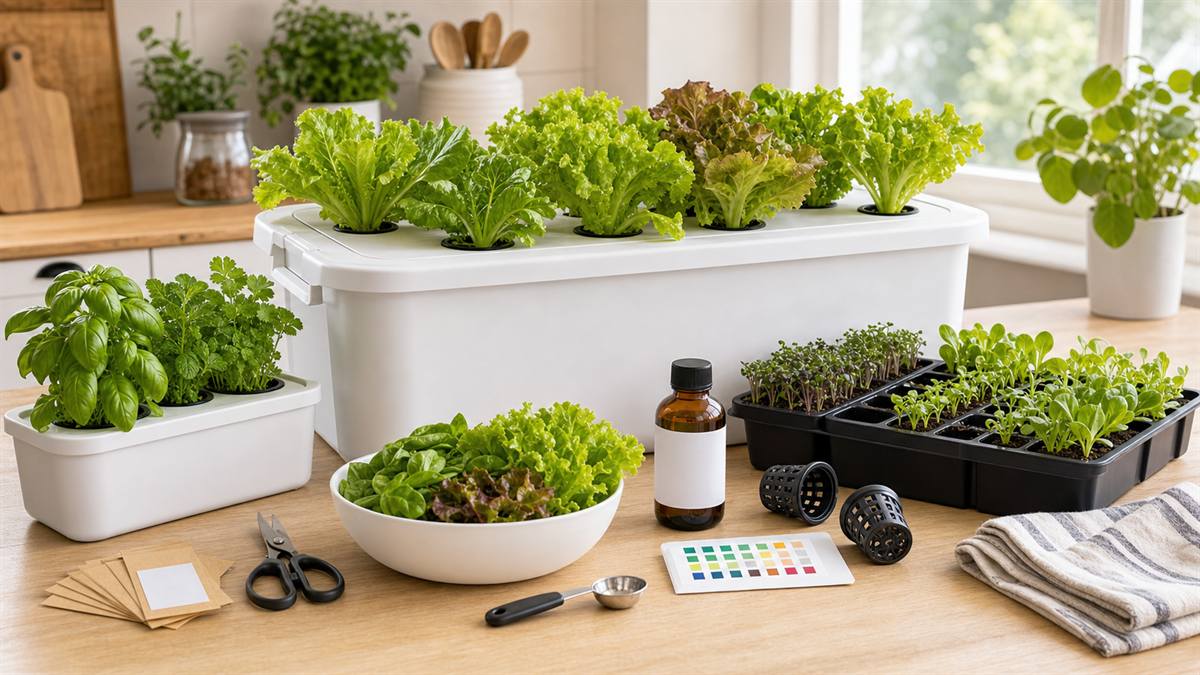
A Rubbermaid tote with net pot holes drilled in the lid is the simplest, cheapest hydroponic system you can build. No pump, no electricity, no timers. Fill it with nutrient solution, drop in your seedlings, and the plants essentially manage themselves. Total cost: $15–$30. This is the system I recommend to every beginner, and it’s what most people use to grow their first hydroponic lettuce or basil.
2. The 5-Gallon Bucket DWC System
One 5-gallon bucket, a small air pump, an air stone, and a net pot lid. This is deep water culture at its simplest — roots are submerged in aerated nutrient solution. Each bucket grows one large plant (tomatoes, peppers, cucumbers) or can be fitted with a multi-hole lid for greens. Cost: $20–$35. Link multiple buckets together and you have a scalable system for under $100.
3. PVC Pipe NFT System (Best for Scaling Up)
A PVC pipe hydroponic system is the backbone of most small commercial operations. You’ll use 2- or 3-inch PVC pipes with holes cut for net pots, a reservoir, and a submersible pump to circulate the nutrient film. A 6-pipe system can hold 30–48 plants in a spare bedroom or garage. Materials: $60–$120. See our guide on how to build a hydroponic system at home for exact step-by-step instructions for all three builds.
4. Shelving Unit Indoor Garden (Best for Year-Round Indoor Growing)
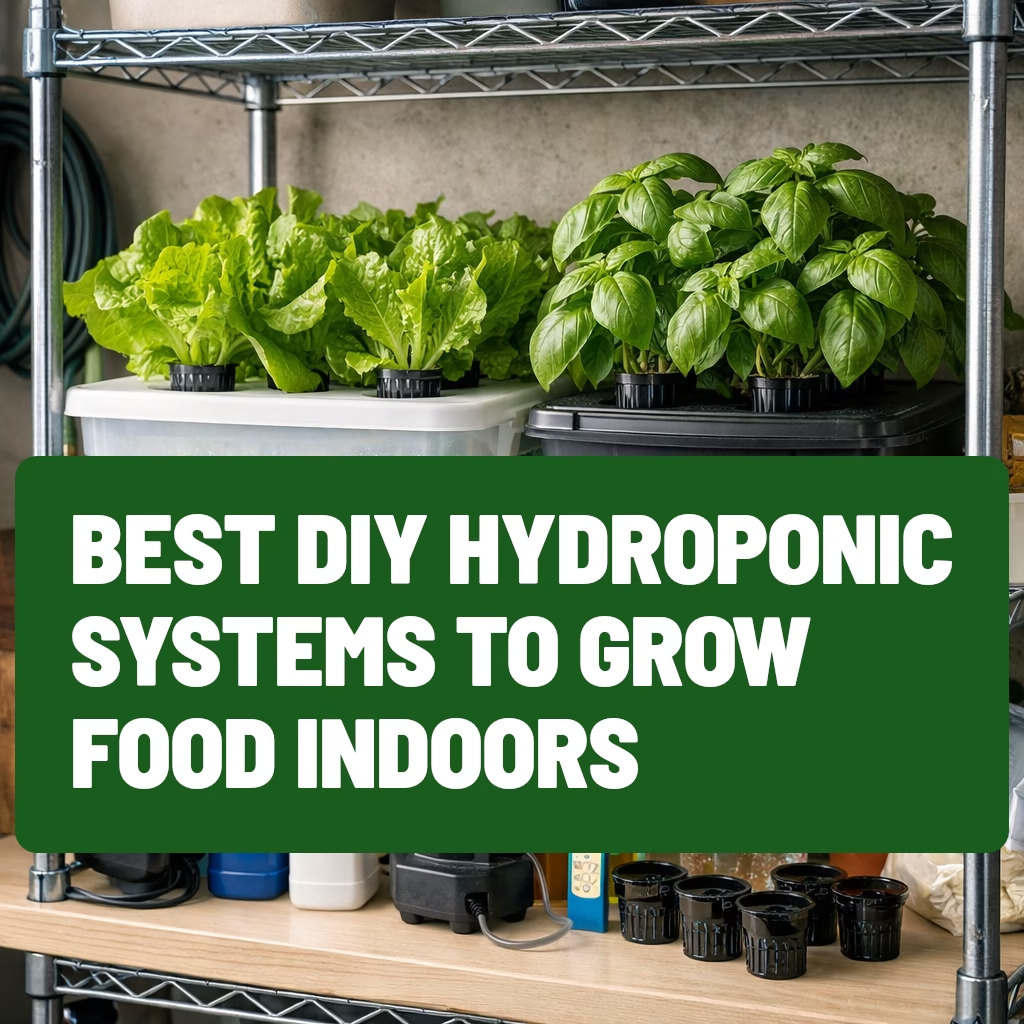
Once you add LED grow lights, you’re fully untethered from the sun. A wire shelving unit with two 45W LED panels and a Kratky or DWC reservoir on each shelf can produce a continuous harvest of leafy greens and herbs in any room of your home. Budget: $80–$150 to start. For the complete indoor setup walkthrough, see our indoor hydroponic garden setup guide.
The Kratky Method: The Easiest Starting Point
If you want to grow your first hydroponic plants this weekend with zero pumps, zero timers, and zero electricity, the Kratky method is your answer. We’ve written an entire step-by-step guide on the Kratky method for beginners, but here’s the core idea.
You suspend a plant in a net pot above a reservoir of nutrient water. The roots grow down into the solution. As the plant drinks the water level down, an air gap forms between the water surface and the bottom of the net pot — and that air gap is what keeps the upper roots oxygenated. The plant manages itself.
What you need for a basic Kratky setup:
- Any opaque container (mason jar, storage tote, 5-gallon bucket)
- Net pots (2-inch is standard for leafy greens)
- Hydroton clay pebbles or rockwool as growing medium
- Hydroponic nutrients (a basic 2-part liquid fertilizer works fine)
- Seeds or seedlings
- pH test kit or drops (aim for 5.5–6.5)
That’s it. I’ve grown full heads of romaine in Kratky jars on a south-facing windowsill. It’s genuinely that simple. Kratky works best for: lettuce, spinach, kale, basil, cilantro, and other leafy greens. For a storage-tote version that can grow 6–12 plants at once, see our guide to Kratky method lettuce in a storage tote.
How to Start Seeds for Hydroponics
Starting seeds for a hydroponic system is a little different from direct-sowing in soil. The goal is to get your seedling’s roots established in a soil-free medium so they’ll thrive when transferred to your reservoir. Here’s the quick overview — for a full picture, see our dedicated post on how to start seeds for hydroponics the easy way.
Option 1: Rockwool Cubes
Pre-soak rockwool cubes in pH-adjusted water (5.5). Drop one or two seeds into the pre-formed hole, keep the cube moist but not waterlogged, and place under a dome or in a warm spot (70–75°F). Seedlings are ready to transfer to your system in 7–14 days, once roots are visible poking out the bottom of the cube.
Option 2: Rapid Rooter Plugs
These composted bark plugs are beginner-friendly and require no pre-soaking. Same process as rockwool: seed goes in the hole, keep warm and moist, wait for root emergence. Works especially well in Kratky and DWC setups.
Option 3: Direct-to-Kratky
For lettuce and herbs, you can skip the seedling phase entirely and germinate directly in a net pot filled with rinsed clay pebbles. Place 2–3 seeds in each net pot, keep the bottom of the pebbles just touching the nutrient solution, and thin to the strongest seedling once germinated. Slower to start but requires zero extra equipment.
Hydroponic Nutrients 101
This is where beginners tend to overthink things. You don’t need a shelf full of supplements. You need a good base nutrient solution and a basic understanding of what’s in it. We’ve covered this in depth in our guide to hydroponic nutrients for beginners and our separate post on how to mix a hydroponic nutrient solution. Here are the essentials.
The Big Three: N, P, K
Every hydroponic nutrient formula delivers nitrogen (N), phosphorus (P), and potassium (K) — the same NPK you see on any bag of garden fertilizer. In hydroponics, plants also need calcium, magnesium, and micronutrients (iron, manganese, zinc, etc.) that soil would normally provide. A good 2-part or 3-part liquid formula like General Hydroponics Flora Series covers all of this. Follow the manufacturer’s mixing instructions, check your pH, and you’re done.
pH: The One Thing You Cannot Ignore
If there’s one mistake that kills more beginner hydroponic grows than anything else, it’s ignoring pH. Plants in hydroponics need a solution pH between 5.5 and 6.5 to absorb nutrients properly. Outside that range, you’ll see yellowing leaves and stunted growth even if your nutrient mix is perfect. Get a basic pH test kit ($5–$8) or a digital pH meter ($15–$25). Check every few days and adjust with pH Up or pH Down solution — small bottles last a long time.
EC/PPM: Measuring Nutrient Strength
EC (electrical conductivity) tells you how concentrated your nutrient solution is. For leafy greens, you want a lower EC (0.8–1.6 mS/cm). For fruiting crops like tomatoes, go higher (2.0–3.5). A basic EC/TDS meter runs $10–$15 and is worth it once you’re growing seriously. Check it alongside pH at every reservoir inspection.
When to Change Your Nutrient Solution
For Kratky, you typically don’t change the solution during a single grow cycle — just top it off with fresh nutrient water as needed. For recirculating systems (DWC, NFT), do a full reservoir change every 1–2 weeks to prevent salt buildup and nutrient imbalances. Always mix fresh solution at the target EC and pH before adding it back.
Best Plants to Grow in a DIY Hydroponic System
Not all plants are created equal in hydroponics. Start with crops that are fast-growing, forgiving, and high-yielding. For a complete breakdown with grow tips for each crop, see our guide to the best plants for DIY hydroponics and our list of the best hydroponic plants for beginners that you can actually sell.
| Plant | Best System | Days to Harvest | Notes |
|---|---|---|---|
| Lettuce | Kratky, DWC, NFT | 30–45 | Best beginner crop. Fast, easy, high market value. |
| Basil | Kratky, DWC | 28–35 | Sells extremely well. Grows explosively in hydroponics. |
| Spinach | Kratky, NFT | 40–50 | Prefers cooler temps. Great cool-season crop. |
| Kale | DWC, NFT | 50–60 | Cut-and-come-again. Very high yield per plant. |
| Tomatoes | DWC, Drip | 60–80 | Higher maintenance but very rewarding indoors. |
| Cucumbers | DWC, Drip | 55–65 | Fast producers. Need vertical support. |
| Strawberries | NFT, Kratky | 90+ (from runners) | Premium market value. Great for NFT towers. |
| Microgreens | Tray system | 7–14 | Fastest ROI. Very popular with restaurants and neighbors. |
My recommendation: start with lettuce and basil. They’ll give you quick wins, teach you the fundamentals, and — if you want to sell — have reliable local demand. Basil in particular grows so fast hydroponically that you’ll be giving it away within a few weeks if you’re not selling it. For a deep dive on growing basil indoors year-round, see our guide to hydroponic basil growing.
Also worth knowing: if you’re deciding between Kratky lettuce and soil-grown lettuce, the speed and yield difference is significant. Our side-by-side hydroponic lettuce vs. soil lettuce comparison breaks down exactly what you gain — and the few cases where soil still wins.
How to Build Your First System: Step-by-Step
Let’s build the simplest possible working system — a Kratky storage tote setup — from scratch. You can have plants in water by the end of today. For a full step-by-step build guide with materials lists for three different system types, see our post on how to build a hydroponic system at home.
What You’ll Need
- 1 opaque storage tote (10–20 gallon) with lid — or a 5-gallon bucket
- 2-inch net pots (one per plant)
- Hydroton clay pebbles (rinsed well)
- Hydroponic nutrients (any 2-part liquid formula)
- Lettuce seeds or seedlings
- pH test kit
- Drill with a 2-inch hole saw bit
Step 1: Drill Your Net Pot Holes
Mark evenly-spaced holes on the lid of your container — for lettuce, 6–8 inches apart. Drill out each hole with the 2-inch hole saw. Clean up any rough edges so the net pots seat cleanly.
Step 2: Mix Your Nutrient Solution
Fill your container with water (filtered, or let tap water sit 24 hours to off-gas chlorine). Mix in nutrients per the manufacturer’s seedling/leafy green instructions. Test pH and adjust to 5.8–6.2. Pour into the container and snap the lid on.
Step 3: Fill Net Pots and Place Seedlings
Add a layer of rinsed clay pebbles to each net pot. Place your seedling in the center and fill around it with more pebbles to support it upright. Press the net pot into the lid hole — it should sit snugly.
Step 4: Set the Water Level
For Kratky, the initial water level should just barely touch the bottom of the net pot — about ¼ inch of contact. As the plant grows and drinks the solution down, the air gap forms naturally. Don’t top up the reservoir unless it gets very low.
Step 5: Provide Light
Place your system in a south-facing window (6+ hours of direct light), or set up a simple LED grow light 6–12 inches above the plants on a 16-hour timer. That’s all leafy greens need. For more on light setup, see our full indoor hydroponic garden setup guide.
Step 6: Monitor and Harvest
Check pH every 3–4 days. Watch for yellowing leaves (pH or nutrient issue). In 30–45 days, you’ll harvest full heads of lettuce. Then refill, replant, and do it again — indefinitely.
Setting Up an Indoor Hydroponic Garden
Growing indoors gives you complete control over your environment — temperature, light duration, humidity — and means you can produce food 365 days a year regardless of what’s happening outside. Here’s what to think about when setting up an indoor hydroponic space. For the full guide, see our indoor hydroponic garden setup walkthrough.
Choosing Your Space
You don’t need a dedicated room. A corner of the basement, a spare closet, a section of the garage, or even a bookshelf in a spare room all work. Ideal conditions: temperatures between 65–78°F, some airflow (a small fan helps prevent mold and tip burn), and access to a drain or sink for water changes.
Grow Lights for Indoor Hydroponics
LED grow lights have become affordable and highly effective. For leafy greens and herbs, a 45W full-spectrum LED panel can cover a 2×2 ft area effectively. Run lights 14–16 hours per day on a timer. Position 6–12 inches above the canopy for most greens, raising the light as plants grow. A decent setup with two lights runs $40–$80 and lasts for years.
Apartment and Small-Space Hydroponics
You don’t need a house to grow hydroponically. A single wire shelving unit with grow lights on each shelf is one of the most space-efficient food production systems that exists. Three shelves of Kratky totes, each 2×4 ft, can grow 40–60 plants of lettuce and herbs in a space the size of a bookcase. For apartment-specific setups, see our guides on indoor gardening in an apartment and pump-free hydroponics for apartments.
Hydroponic Troubleshooting Guide
Things go wrong — especially in the first few grows. Here are the most common problems and exactly what to do. For a comprehensive troubleshooting guide covering more edge cases, see our dedicated hydroponic system troubleshooting post.
| Problem | Likely Cause | Fix |
|---|---|---|
| Yellow leaves | pH out of range OR nutrient deficiency | Test and adjust pH first; check EC/nutrient levels |
| Slimy roots (root rot) | Light reaching reservoir, or low oxygen in DWC | Cover reservoir to block all light; add air stone |
| Algae growth | Light reaching nutrient solution | Use opaque containers; cover any gaps in the lid |
| Slow growth | Low temps, low nutrients, or inadequate light | Keep temps 65–75°F; check EC; upgrade lighting |
| Wilting despite full reservoir | Root rot or very low oxygen | Check roots for brown slime; aerate solution |
| Tip burn on lettuce | Calcium deficiency or poor air circulation | Add small fan; ensure calcium in nutrient mix |
| Leggy seedlings | Not enough light during germination | Move closer to light source; reduce light distance |
| Seeds not germinating | Too cold, too dry, or seeds too deep | Keep 70–75°F; keep medium moist; seeds need light contact |
The good news: most hydroponic problems come back to pH or light contamination of the reservoir. Fix those two things and you’ll solve 80% of what beginners face.
How Much Can You Actually Harvest?
This is the question everyone has — and the answer is more exciting than most people expect. We’ve done a full analysis in our post on hydroponic yield per square foot, but here are the headline numbers.
A single 2×4 ft Kratky tote system (8 square feet) growing lettuce can produce:
- 8–12 heads of lettuce every 35–40 days
- Roughly 8–10 harvests per year with back-to-back growing
- 80–100 heads of lettuce per year from that one system
At $3–$5 per head (farmers market price), that’s $240–$500 per year from a single tote that cost you $25 to build. Scale to four totes and you’re looking at $1,000–$2,000 per year in food value or income from roughly 32 square feet of growing space.
Herbs are even higher value. A 2×4 ft tote of basil can produce 2–3 lbs per harvest, with plants harvested continuously over 60–90 days. Fresh basil sells for $3–$6 per oz at farmers markets. The numbers get very interesting very quickly.
What Does It Really Cost?
One of the biggest myths about hydroponics is that it’s expensive. Here’s what a real beginner setup actually costs. For a full breakdown, see our post on how much it costs to start a hydroponic garden.
| Setup | Approximate Cost | Plants | Best For |
|---|---|---|---|
| Kratky single jar | $5–$10 | 1–3 plants | Testing the concept |
| Storage tote Kratky | $25–$40 | 6–12 plants | First real system |
| 5-gallon bucket DWC | $20–$35 | 1–4 plants | Large fruiting plants |
| PVC pipe NFT system | $60–$120 | 24–48 plants | Scaling up |
| Full indoor setup with lights | $100–$200 | 20–40 plants | Year-round indoor growing |
Ongoing costs are minimal: nutrients ($20–$40 every 3–4 months for a small system), electricity for lights (~$5–$15/month for LED), and replacement net pots or growing medium occasionally. That’s it. The $150 setup that grows 40 plants typically pays for itself in the first two harvests — in food savings alone.
Also worth reading: our comparison of the cheapest hydroponic setups if you’re working with a tight budget, and the breakdown of what growing food indoors actually saves you on your grocery bill.
From Hobby to Income: Making Money with Hydroponics
Once your first system is running, the natural question is: what can I do with all this food? A lot of homesteaders start growing to feed their family, then realize they have more lettuce and basil than they can eat — and that surplus is the beginning of something interesting.
Hydroponic produce is genuinely appealing to buyers. It’s clean, pesticide-free, and fresher than anything in a grocery store. Neighbors, local restaurants, and farmers market shoppers will pay a premium for it. Here’s a quick look at what’s possible:
- Selling to neighbors — The lowest barrier to entry. A few dozen heads of lettuce per month can generate $50–$150 in your own neighborhood. See our guide on how to sell plants to neighbors.
- Farmers markets — The next step up. A small table of hydroponic lettuce, basil, and specialty herbs can bring in $200–$500 on a good Saturday. See our guide on how to sell at farmers markets.
- Hydroponic lettuce business from home — If you’re serious about scaling, our guide to running a hydroponic lettuce business from home walks through exactly what a small-scale operation looks like, what it costs, and what it earns.
- Growing greens for profit — A broader look at the most profitable crops, pricing strategies, and how to move volume. See: growing greens for profit.
The homestead income angle is something we cover extensively on this site — because the whole premise of Profitable Homesteader is that growing food and making money from it aren’t separate goals. They compound each other. For the full picture on homestead income options, see our guide to how to make money homesteading.
Frequently Asked Questions
Is hydroponics hard for beginners?
Not at all — especially starting with the Kratky method. It requires no pumps, no electricity, and minimal monitoring. Most beginners are surprised by how simple their first system is. The learning curve comes later when you scale up or move to more complex systems.
How much does it cost to start a hydroponic garden?
You can start for as little as $5–$10 with a mason jar Kratky setup. A more practical beginner system that grows 6–12 plants costs $25–$50. A full indoor setup with grow lights runs $100–$200. Ongoing costs — nutrients and electricity — are quite low for a small system.
Do hydroponic plants taste as good as soil-grown plants?
In most cases, yes — and sometimes better. Hydroponic lettuce and herbs grown with a well-balanced nutrient solution are consistently crisp and flavorful. Tomatoes and fruiting crops are more variable, but with the right nutrient program and adequate light, the results are excellent. See our hydroponic vs. soil lettuce comparison for a detailed look.
Can I grow hydroponics without a grow light?
Yes, if you have a bright south-facing window that gets 6+ hours of direct light. Leafy greens and herbs can do well with good natural light. For fruiting crops or limited windows, a basic LED grow light ($25–$50) makes a significant difference and pays for itself quickly in year-round production.
What is the cheapest hydroponic setup?
The Kratky method in a mason jar — under $10 if you already have a jar. A storage tote with multiple net pot holes in the lid is the next step up, buildable for $20–$30. Neither requires a pump or electricity beyond lighting. See our cheapest hydroponic setups guide for a full comparison.
What’s the difference between Kratky and deep water culture?
The key difference is aeration. In DWC, an air pump constantly oxygenates the nutrient solution, allowing roots to be fully submerged. In Kratky, there’s no pump — the air gap that forms as the plant drinks the solution down provides the oxygen. Kratky is simpler and cheaper; DWC supports faster growth and works better for larger plants.
How often do I need to change the water?
For Kratky, you typically don’t change the water during a grow cycle — just top off as needed with fresh nutrient solution. For recirculating systems (DWC, NFT), aim for a full reservoir change every 1–2 weeks to prevent salt buildup and nutrient imbalances.
How do I start seeds for a hydroponic system?
The most common methods are rockwool cubes, Rapid Rooter plugs, or germinating directly in clay pebbles. Each works well for different setups. See our complete guide on how to start seeds for hydroponics for step-by-step instructions.
Ready to stop reading and start growing? The Indoor Mini Farm System walks you through building your first productive system from scratch — exact materials lists, budget options at every price point, and a 30-day plan to get your first harvest. It’s everything I wished I’d had when I started.