The hydroponics industry has a vested interest in making you think you need a $400 grow tent, a $150 nutrient kit, and a $200 LED system before you can grow a single leaf of lettuce. You don’t. Not even close.
I grew my first hydroponic lettuce in a $4 storage bin from a dollar store. It worked perfectly. That crop — and the dozen that followed — taught me everything I needed to know before I invested in anything more sophisticated.
Here’s exactly how to build the cheapest hydroponic setup that actually works, what each component costs, and where you can cut corners without hurting your results.
Table of Contents
- What You Actually Need (The Non-Negotiables)
- The $5–$10 Setup: Single Jar Kratky
- The $20–$30 Setup: Storage Tote Kratky (6–12 Plants)
- The $40–$50 Setup: Full Beginner System with Grow Light
- Where to Buy Hydroponic Supplies Cheap
- What to Skip Entirely as a Beginner
- Ongoing Costs: What You’ll Spend Per Month
- Is a Cheap Hydroponic Setup Worth It?
- Frequently Asked Questions
What You Actually Need (The Non-Negotiables)
Before we price anything out, it helps to understand what a hydroponic system actually requires at minimum. Strip away all the marketing and you need five things:
- A container to hold your nutrient solution
- A way to suspend plants above or in the solution (net pots)
- Something to anchor the plant in the net pot (growing medium)
- Nutrients dissolved in the water (hydroponic fertilizer)
- A way to check and adjust pH (the one thing you truly cannot skip)
Light is the sixth requirement — but if you have a sunny south-facing window, you already have it for free. Everything else on any product page beyond these five is optional, at least for your first grow.
The $5–$10 Setup: Single Jar Kratky
This is the absolute floor — the simplest hydroponic setup that actually grows food. It uses the Kratky passive method: no pump, no electricity, no moving parts.
What You Need
| Item | Where to Get It | Cost |
|---|---|---|
| Mason jar or opaque container (32 oz+) | Dollar store, kitchen cupboard | $0–$2 |
| 1–2 net pots (2-inch) | Amazon, garden center | $1–$2 (sold in packs) |
| Small bag of clay pebbles or rockwool | Amazon, garden center | $3–$5 (lasts many grows) |
| Hydroponic nutrients (small bottle) | Amazon, garden center | $8–$12 (lasts months) |
| pH test drops | Amazon, pet store (aquarium section) | $5–$8 |
| Seeds (lettuce or basil) | Dollar store, garden center | $1–$3 |
Total first-time cost: $18–$32. But here’s the thing — the nutrients, pH drops, clay pebbles, and net pots will last through many, many grows. Your true per-grow cost after the first setup is closer to $1–$2 in seeds and a small amount of nutrients.
Pro tip: The aquarium section of a pet store often sells pH test kits for less than the garden section of a hardware store. Same product, different aisle.
What it grows: 1–2 plants. Ideal for herbs on a windowsill — one basil jar on a sunny kitchen counter is genuinely useful and requires almost zero attention.
The $20–$30 Setup: Storage Tote Kratky (6–12 Plants)
This is where the math starts to get interesting. For about $25–$30 total, you can build a system that grows 6–12 plants simultaneously — enough lettuce and herbs to make a real dent in your grocery bill.
| Item | Where to Get It | Cost |
|---|---|---|
| Opaque storage tote with lid (10–18 gallon) | Dollar store, Walmart, hardware store | $4–$8 |
| Pack of 2-inch net pots (50 count) | Amazon | $5–$7 |
| Small bag hydroton clay pebbles | Amazon, garden center | $8–$12 |
| Hydroponic nutrients | Amazon (MaxiGro dry powder is cheapest per gallon) | $10–$15 |
| pH test kit | Amazon, pet store | $5–$8 |
| Seeds | Dollar store, Amazon | $2–$4 |
| 2-inch hole saw bit (for lid) | Hardware store, or use a sharp knife | $0–$8 |
Total first-time cost: $34–$62. Again, most of this is reusable. After the first grow, you’re replacing seeds and a small amount of nutrients — maybe $3–$5 per crop cycle.
If you already have a sunny window, this setup produces a continuous supply of fresh lettuce and herbs essentially for free after the initial investment. Six heads of lettuce every 35 days, at $3–$5 per head at the grocery store, pays back the setup cost in one or two harvests.
The Cheapest Tote Hack
Dollar Tree sells 5-gallon buckets and rectangular storage containers for $1.25–$4. These are thinner than hardware store versions but work perfectly for a Kratky system — you’re not putting stress on them, just filling them with water. Many growers run their first several systems from dollar store containers exclusively.
The $40–$50 Setup: Full Beginner System with Grow Light
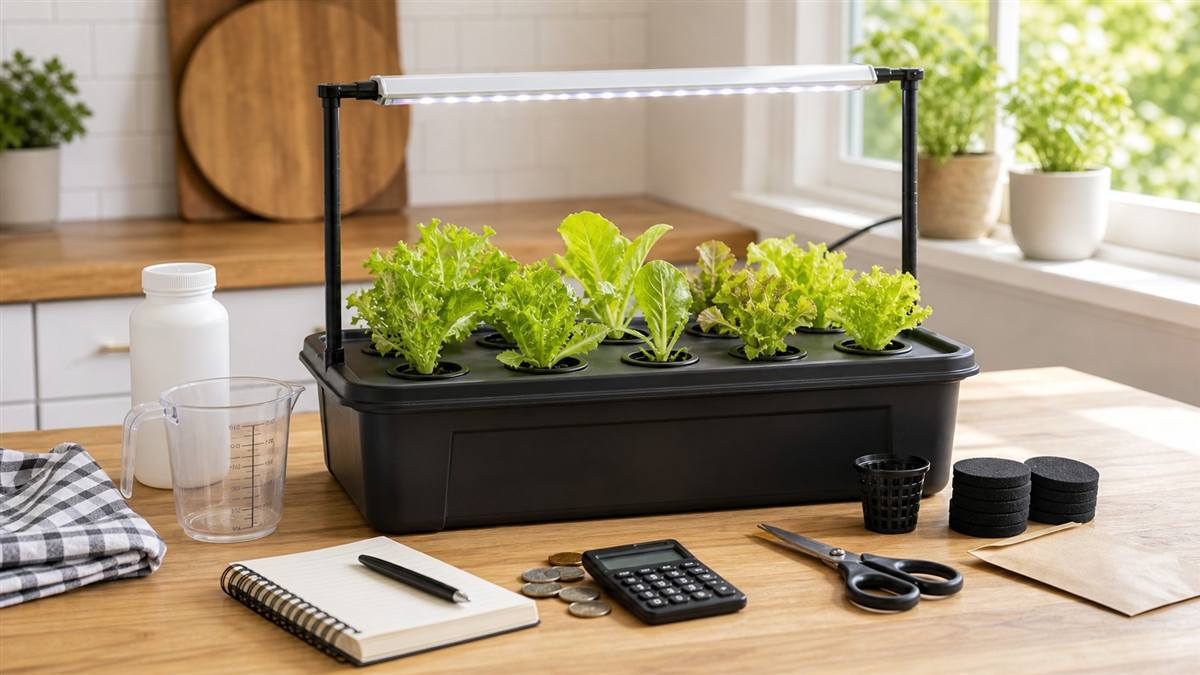
Add a grow light and you’re untethered from the sun entirely. This is the setup that makes year-round growing truly independent of season, window placement, or weather — and it can all be done for under $50 if you shop smartly.
| Item | Best Budget Option | Cost |
|---|---|---|
| Storage tote setup (as above) | Dollar store tote + Amazon net pots | $20–$30 |
| LED grow light (basic panel) | Amazon — search “45W full spectrum LED grow light” | $18–$28 |
| Outlet timer | Any hardware store or Amazon | $8–$12 |
Total: $46–$70 for everything. The grow light and timer are one-time purchases that last years. At the lower end of shopping — dollar store container, Amazon net pots and nutrients in small quantities, a basic LED panel — this comes in right at $50.
This is the setup described in the complete DIY hydroponics guide as the ideal starting point: simple enough to build in an afternoon, productive enough to grow real food, and cheap enough that there’s no financial pressure if your first grow isn’t perfect.
Where to Buy Hydroponic Supplies Cheap
The markup at dedicated hydroponics stores is significant. Here’s where experienced growers actually shop:
Amazon
The best source for net pots, clay pebbles, nutrients in small quantities, pH kits, and grow lights. Search for the generic product rather than brand names — “2 inch net pots 50 pack” rather than a specific brand. Read reviews carefully on nutrients and lights; quality varies.
Dollar Tree / Dollar General
Containers, buckets, and basic supplies. Some locations carry seed packets for $1.25. Black spray paint for making translucent containers opaque. Measuring cups and spoons for mixing nutrients.
Walmart Garden Center
General Hydroponics nutrients are sometimes stocked here at prices competitive with Amazon. Also a good source for perlite, which works as a growing medium in a pinch.
Pet Stores (Aquarium Section)
pH test kits marketed for aquariums are chemically identical to hydroponic pH kits and often cheaper. Air pumps and airstones for DWC systems are also usually cheaper in the aquarium section than at a garden store.
Facebook Marketplace / Buy Nothing Groups
Growers who’ve scaled up often give away or sell cheaply their starter equipment. Worth a search for “hydroponics,” “grow light,” or “storage totes.” You can sometimes build your entire first system for free this way.
What to Skip Entirely as a Beginner
The hydroponics market is full of products that solve problems you don’t have yet. Here’s what experienced growers wish they hadn’t bought first:
- Grow tents — Useful for light efficiency and smell control, not necessary for leafy greens and herbs on a shelf
- Expensive multi-part nutrient systems — A single complete formula like MaxiGro works beautifully for all leafy greens
- Root stimulators and bloom boosters — You’re growing lettuce, not trying to win a cannabis yield contest
- Automated pH dosing systems — A $6 test kit and manual adjustment is all you need at small scale
- CO2 supplementation — Only relevant in sealed, high-intensity growing environments
- High-end EC/TDS meters — A $10 budget meter is fine for a beginner setup; upgrade later if you scale
- Hydroponic “kits” — Pre-packaged starter kits almost always include things you don’t need and charge a premium for the convenience
Ongoing Costs: What You’ll Spend Per Month
One of the best things about a simple Kratky or beginner hydroponic system is how cheap it is to run after the initial setup. Here’s a realistic monthly cost breakdown for a single-tote system growing 6–8 plants:
| Expense | Monthly Cost | Notes |
|---|---|---|
| Seeds | $1–$2 | One packet grows many, many crops |
| Nutrients | $1–$3 | A $10 bag of MaxiGro makes ~100 gallons of solution |
| Electricity (grow light) | $2–$5 | 45W LED, 16 hrs/day ≈ 21 kWh/month |
| Water | Negligible | A passive Kratky tote uses very little water |
| pH adjustment solutions | <$1 | A small bottle lasts 6–12 months |
| Total | $4–$11/month |
Compare that to what a tote producing 6 heads of lettuce per month is worth — $18–$30 at grocery store prices — and the return on a cheap hydroponic setup is genuinely remarkable. That math is exactly why so many people who start growing to save money end up growing enough to sell too.
Is a Cheap Hydroponic Setup Worth It?
The question isn’t really whether a cheap setup works — it does, reliably, if you get the pH right and give it decent light. The real question is whether the produce value justifies the time and initial investment.
For most people who try it: yes, clearly. A $30–$50 setup that runs for years and produces $15–$30 worth of fresh food per month is a genuinely good deal. And that’s just feeding your family.
The growers who take it a step further — setting up multiple totes and selling living plants to neighbors — find the numbers get even more interesting. A ready-to-harvest lettuce tote sells for $30–$50. Three totes a week at that price is meaningful income from equipment that cost less than a tank of gas to buy.
If that model appeals to you, the Indoor Mini Farm System is exactly what we built around it — a complete guide to going from a cheap beginner setup to a small neighborhood selling operation, without needing land, a green thumb, or a big upfront investment.
Frequently Asked Questions
What is the cheapest way to start hydroponics?
The cheapest functional hydroponic setup is a single mason jar using the Kratky method — a net pot, a handful of clay pebbles or rockwool, nutrient solution, and a pH test kit. Total cost is $10–$20 for the first grow, with subsequent grows costing under $2. It’s not the most scalable setup, but it absolutely works and teaches you every fundamental you need.
Can you do hydroponics for under $50?
Yes — including a grow light. A dollar store storage tote, a pack of net pots, a small bag of clay pebbles, a basic nutrient formula, a pH kit, and a budget LED grow light with a timer can all be assembled for $45–$55. Shopping at dollar stores for the container and Amazon for the grow components brings this in at or under $50 for most people.
Do I need a pump for a cheap hydroponic setup?
No. The Kratky method requires no pump whatsoever. Plants sit above the nutrient solution and develop an air gap naturally as they drink the water down — that gap provides the oxygen roots need. For leafy greens and herbs, a pumpless Kratky system produces results that are indistinguishable from more complex active systems.
What is the cheapest hydroponic system to build at home?
A Kratky storage tote system is the cheapest to build and one of the cheapest to run. It requires no pump, no timer (beyond one for the grow light), and no electricity beyond lighting. Materials can be sourced from dollar stores and Amazon for $25–$40 total. It scales easily — add more totes as your confidence grows.
How long until a cheap hydroponic setup pays for itself?
A $50 setup growing 6 heads of lettuce every 35 days produces roughly $18–$30 worth of food per harvest at grocery store prices. Most setups pay for themselves within 2–3 harvests — about 2–3 months. After that, the ongoing cost is $4–$10 per month in seeds, nutrients, and electricity.
Is hydroponics cheaper than buying vegetables?
For high-turnover crops like lettuce, basil, and spinach — yes, significantly cheaper after the first harvest or two. Organic lettuce runs $3–$6 per head at most grocery stores. A hydroponic tote growing 6 heads costs $4–$8 per month to run. The savings compound quickly, especially for families that eat a lot of salads and fresh herbs.
The cheapest hydroponic setup is the one you actually build and run. Start with a tote and a bag of seeds. Get one harvest under your belt. Then decide how far you want to take it. If you’re ready to see what it looks like when a simple setup turns into something that also earns a little income, the Indoor Mini Farm System is the place to start.