New to Kratky? Start with our complete beginner’s overview covering gear, common mistakes, and how much you can earn. This post goes deeper on the step-by-step build.
The first time someone told me I could grow lettuce in a jar with zero pumps, zero timers, and zero electricity, I was pretty skeptical. That sounds like something that works great in a YouTube video and fails the moment you try it at home.
But the Kratky method is genuinely that simple — and it works. I’ve grown full heads of romaine, basil that outpaces anything from the grocery store, and enough spinach to keep smoothies running all winter. All from a container on a shelf with no moving parts whatsoever.
If you’ve been curious about hydroponics but felt put off by the equipment, the wiring, or the learning curve — start here. The Kratky method is your on-ramp.
Table of Contents
- What Is the Kratky Method?
- How It Works (The Clever Science Behind It)
- What You Need to Get Started
- Step-by-Step: Your First Kratky Setup
- Best Plants for the Kratky Method
- Tips for a Successful Kratky Grow
- Kratky vs. Other Hydroponic Systems
- Kratky Troubleshooting
- Ready to Scale Up?
- Frequently Asked Questions
What Is the Kratky Method?
The Kratky method is a passive, non-circulating hydroponic technique developed by Dr. B.A. Kratky at the University of Hawaii. Plants grow in net pots suspended above a reservoir of nutrient solution. Roots grow down into the water — and as the plant drinks the solution, an air gap forms naturally between the water surface and the bottom of the net pot. That air gap provides the oxygen roots need without any pump or airstone.
The system essentially manages itself. You mix your nutrients once, set your plants, and come back in 30–45 days to harvest. No electricity required beyond lighting. No maintenance beyond the occasional pH and water level check.
It’s the foundation of what I now grow year-round indoors — and it’s a big part of why the DIY hydroponics approach works so well even for total beginners.
How It Works (The Clever Science Behind It)
Plant roots need two things to thrive: water and oxygen. In soil, the spaces between soil particles hold both. In most hydroponic systems, a pump aerates the water to deliver oxygen to submerged roots. The Kratky method solves this problem differently — and more elegantly.
When you first set up a Kratky system, the nutrient solution level sits just high enough to touch the bottom of the net pot and wet the growing medium. As the plant drinks the solution down over days and weeks, the water level drops. This creates a growing air gap between the water surface and the net pot.
The lower portion of the roots stays submerged in nutrients. The upper portion — in the air gap — absorbs oxygen directly. The plant has everything it needs, delivered passively, with no intervention from you.
It’s one of those ideas that’s almost too simple to believe until you see it working.
What You Need to Get Started
This is where Kratky really shines. You don’t need a specialized kit or a trip to a hydroponics store. Most of this you can find at a hardware store, a garden center, or online for under $30 total.
The Container
Any opaque container works — the key word being opaque. Light reaching your nutrient solution causes algae growth, which competes with your plants and clouds the water. Good options:
- Mason jars wrapped in tape or painted — perfect for a single plant or herb
- Opaque storage totes (10–20 gallon) with lids — grow 6–12 plants at once
- 5-gallon buckets with lids — great for a single larger plant or 3–4 small ones
- Purpose-built Kratky reservoirs — available online if you want something cleaner-looking
For a first grow, a $5 storage tote from a dollar store or hardware store is genuinely all you need.
Net Pots
Net pots are the small mesh cups that hold your plant and growing medium above the reservoir. Two-inch net pots are standard for lettuce and herbs. You’ll cut corresponding holes in your container lid using a hole saw or a sharp knife.
A pack of 50 net pots costs $5–$8 online. You’ll use them over and over.
Growing Medium
The growing medium anchors your plant in the net pot and wicks moisture up to the roots while they’re still developing. The most common options:
- Hydroton clay pebbles — reusable, pH-neutral, good drainage. Most popular choice.
- Rockwool cubes — excellent for seed starting; drop the whole cube into the net pot
- Coco coir — works well, retains moisture, sustainable
- Perlite — cheap and effective, though it floats until it gets wet
Nutrients
You’ll need a hydroponic-specific nutrient solution — regular garden fertilizer won’t cut it because it’s designed for soil microbes to break down, not direct root absorption. A simple 2-part or 3-part liquid formula works perfectly for Kratky. General Hydroponics Flora Series and MaxiGro are both reliable beginner choices.
Mix per the manufacturer’s instructions for the “grow” or “seedling” phase when targeting leafy greens.
pH Testing
This is non-negotiable. Hydroponic plants need a solution pH of 5.5–6.5 to absorb nutrients. A basic pH test kit costs $5–$8 and lasts for dozens of grows. A digital pH meter ($15–$25) is more convenient if you’re growing regularly. You’ll also need pH Up and pH Down solutions to adjust — small bottles last a long time.
Light
For leafy greens and herbs, a bright south-facing window (6+ hours of direct sun) is workable. For more reliable year-round results, a basic LED grow light positioned 6–12 inches above your plants on a 14–16 hour timer is the way to go. A decent 45W LED panel runs $20–$35 and handles one or two trays of greens easily.
Step-by-Step: Your First Kratky Setup
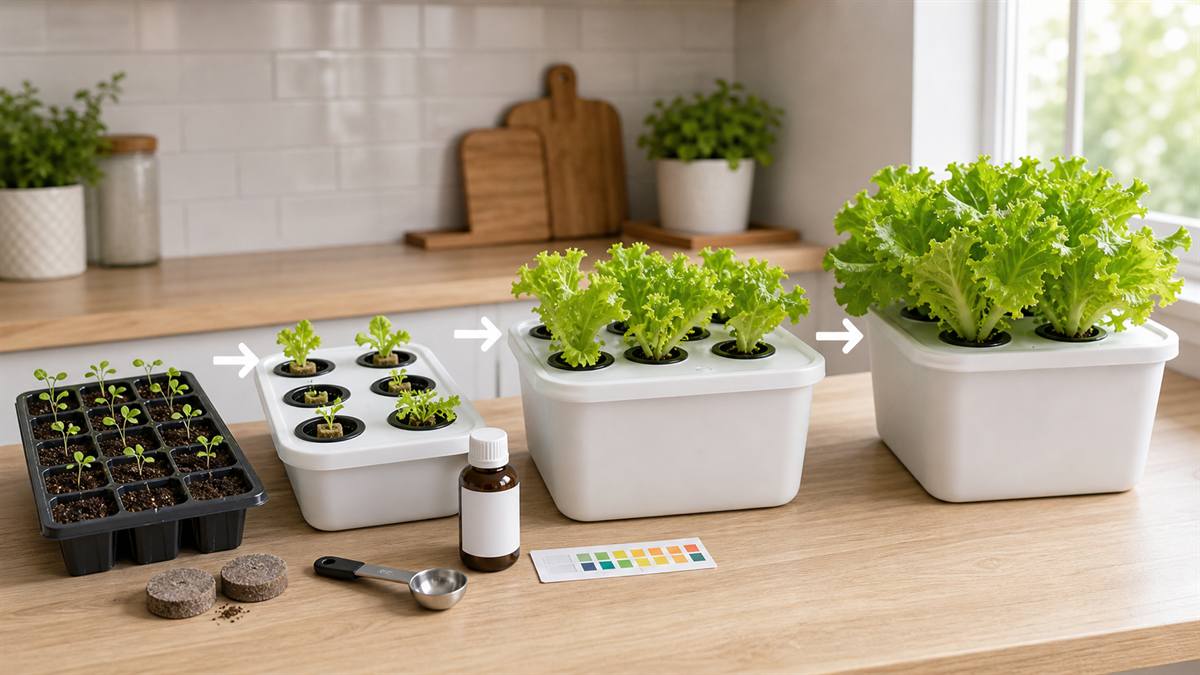
Let’s walk through a complete first setup — a storage tote Kratky system growing 6 heads of lettuce. Budget: around $25–$35 if you’re starting from scratch.
Step 1: Prepare Your Container
Take your opaque storage tote and lid. Using a 2-inch hole saw (or a sharp utility knife), cut evenly spaced holes across the lid — one per plant. For standard lettuce, space holes about 6 inches apart. Six holes fit comfortably on most 10-gallon totes.
If your tote is translucent rather than fully opaque, wrap the outside in black electrical tape or spray paint it black before filling. No light should reach the inside.
Step 2: Mix Your Nutrient Solution
Fill the tote with water. If you’re on city water, let it sit uncovered for 24 hours first to off-gas chlorine, or use filtered water. Add your nutrients per the mixing instructions — follow the “seedling” or “vegetative” rate for leafy greens.
Test pH with your kit or meter. Adjust to 5.8–6.2 using pH Up or pH Down, adding a few drops at a time and stirring. Retest until you’re in range.
Step 3: Prepare Net Pots and Seedlings
Add a layer of rinsed clay pebbles to the bottom of each net pot. Place your seedling (or a small rockwool cube with a germinated seed) in the center. Fill around it with more pebbles, pressing gently to hold the plant upright. The pebbles should sit flush with or just below the rim of the net pot.
If you’re starting from seed rather than a seedling, germinate in a rockwool cube first — just moisten the cube, tuck the seed in, and keep it in a warm dark place for 3–5 days until it sprouts. Then transfer to the net pot.
Step 4: Set the Water Level
Place the net pots into the holes in the lid. The initial water level should just barely touch the bottom of the net pot — about ¼ inch of contact. You want the growing medium to wick moisture up to the roots, but you don’t want the plant drowning.
As the plant grows, it will drink the solution down. The water level will drop on its own, creating the air gap that oxygenates the upper roots. Do not top up the reservoir constantly — let that gap form. For a full grow cycle, you may only need to top up once or twice if the reservoir gets very low before harvest.
Step 5: Position Under Light
Place your system where it will receive adequate light — either a strong window or under your grow light. If using a timer, set it for 14–16 hours of light per day for leafy greens.
Step 6: Monitor and Harvest
Check pH every 3–4 days for the first couple of weeks. Peek at the water level weekly. Watch for any yellowing or stunted growth — usually a sign of pH drift or insufficient light.
In 30–45 days, your lettuce will be full and ready to harvest. Cut outer leaves for a continuous harvest, or pull the whole plant and replant immediately for a continuous cycle.
Best Plants for the Kratky Method
Kratky works best with plants that have moderate nutrient and oxygen needs. Fast-growing leafy greens are the sweet spot — they’re forgiving of beginner mistakes and ready to harvest before the static reservoir causes any issues.
| Plant | Days to Harvest | Notes |
|---|---|---|
| Lettuce (all types) | 30–45 | The classic Kratky crop. Fast, easy, reliable. |
| Basil | 28–35 | Grows explosively. Great seller at markets. |
| Spinach | 40–50 | Prefers cooler temps. Excellent winter crop. |
| Kale | 50–60 | Cut-and-come-again. Very high yield per plant. |
| Swiss chard | 50–60 | Colorful and hardy. Handles pH variation well. |
| Cilantro | 30–40 | Bolts fast in heat — ideal in cooler seasons. |
| Mint | 30–40 | Extremely vigorous. Keep it in its own container. |
| Watercress | 20–30 | Loves water. One of the most nutrient-dense options. |
Stick to this list for your first few grows. Once you’ve got the basics dialed in, you can experiment with fruiting crops — though tomatoes and peppers will need a pump-based system for best results, as their higher oxygen demands push beyond what passive Kratky can reliably provide.
Tips for a Successful Kratky Grow
Don’t obsess over topping up. The most common beginner mistake is refilling the reservoir too frequently, which prevents the air gap from forming. Trust the process. Let the water level drop.
Keep the lid on. Light in the reservoir = algae. Always keep the lid fully on and seal any gaps around the net pots with a bit of tape or a piece of foil if needed.
Start with fewer plants than you think you need. Six lettuce plants in a tote will produce more food than most families can eat in a week. Start small, build confidence, then scale.
Label your containers. If you’re running multiple varieties or staggered grows, label each tote with the plant variety and start date. It takes 10 seconds and saves a lot of guessing.
Stagger your plantings. Start a new tote every two weeks and you’ll have a continuous harvest instead of a glut all at once. This is the key to running a consistent supply — especially if you’re selling what you grow.
Kratky vs. Other Hydroponic Systems
| System | Pump Required? | Electricity? | Complexity | Best For |
|---|---|---|---|---|
| Kratky | No | No (beyond light) | ⭐ Lowest | Leafy greens, herbs, beginners |
| Deep Water Culture | Yes (air pump) | Yes | ⭐⭐ Low | Fast-growing greens, some fruiting |
| NFT | Yes (water pump) | Yes | ⭐⭐⭐ Medium | Herbs, lettuce at scale |
| Ebb & Flow | Yes | Yes + timer | ⭐⭐⭐ Medium | Variety of crops |
| Drip System | Yes | Yes + timer | ⭐⭐⭐⭐ Higher | Tomatoes, peppers, cucumbers |
Kratky wins on simplicity, cost, and silence — it’s ideal for apartments where noise is a concern, or for anyone who wants to start growing without investing in a full system. For a deeper look at how all the system types compare, the complete DIY hydroponics guide walks through each one in detail.
If you’ve already tried the Kratky method and want to see what a pump-free beginner system looks like at the next level, that’s worth a read too.
Kratky Troubleshooting
| Problem | Likely Cause | Fix |
|---|---|---|
| Yellow leaves | pH out of range | Test and adjust pH to 5.8–6.2 |
| Slow growth | Low light or low nutrients | Move closer to light source; check EC/nutrient levels |
| Algae in reservoir | Light reaching solution | Cover all gaps; ensure container is fully opaque |
| Wilting despite full reservoir | No air gap formed; roots drowning | Let water level drop naturally — don’t top up |
| Brown slimy roots | Root rot from light exposure or overwatering | Block all light from reservoir; ensure air gap exists |
| Tip burn on lettuce | Calcium deficiency or low airflow | Add a small fan nearby; check calcium in nutrient mix |
| Leggy, stretched seedlings | Insufficient light | Lower grow light or move to brighter window |
Ready to Scale Up?
Once you’ve harvested your first Kratky tote, something shifts. You start doing math. If six plants fit in one tote, and each head of lettuce takes 35 days to grow, and a fresh living lettuce plant sells for $8–$12 at a farmers market or to a neighbor — what happens when you run three totes?
That’s when the hobby starts to look like something more interesting. The Kratky method is the perfect proof of concept before you invest in anything larger. And the good news is, the skills transfer directly — understanding pH, nutrient mixing, and plant cycles is the same whether you’re running one jar or twenty totes.
If you’re ready to turn your Kratky setup into a system that feeds your family and earns extra income, the Indoor Mini Farm System walks through exactly how to do that — from setting up multiple totes to building a simple neighborhood selling operation that runs on about 30 minutes a week.
See how the Indoor Mini Farm System works →
Frequently Asked Questions
Does the Kratky method really work without a pump?
Yes — that’s the whole point. The Kratky method relies on a passive air gap that forms naturally as the plant drinks down the reservoir. The upper roots absorb oxygen from this gap while the lower roots stay in the nutrient solution. No pump, no airstone, no electricity required beyond your grow light.
How often do I need to check a Kratky system?
Once it’s set up and running, a quick check every 3–4 days is plenty — mainly to glance at the water level and look for any signs of yellowing. It’s genuinely low-maintenance, which is a big part of why it works well for busy people.
Can I grow tomatoes with the Kratky method?
Technically yes, but it’s not ideal. Tomatoes are heavy feeders with high oxygen demands at the roots — they do much better in an active system with an air pump (Deep Water Culture) or a drip system. For Kratky, stick to leafy greens and herbs where it really shines.
How much does a Kratky setup cost?
A single-tote system that grows 6 plants can be built for $25–$35 including nutrients, net pots, growing medium, and the container. A basic LED grow light adds another $20–$35 if you need it. That’s a complete, functional system for under $60.
Do I need to change the water in a Kratky system?
For most leafy green grow cycles (30–50 days), you typically won’t need to do a full water change. You may top up the reservoir once or twice if it gets very low. Mix fresh nutrient solution at the same concentration when you top up — don’t add plain water, as this dilutes your nutrients.
What’s the difference between Kratky and Deep Water Culture?
The main difference is aeration. Deep Water Culture uses an air pump and airstone to continuously oxygenate the nutrient solution, keeping roots submerged at all times. Kratky relies on the passive air gap instead. DWC is slightly more forgiving for a wider range of crops, but requires electricity and more equipment. For leafy greens and herbs, Kratky produces comparable results with far less setup.
The Kratky method is the proof of concept. Once you’ve seen how well plants grow in water — faster, cleaner, and with less work than soil — it’s hard to go back. If you want to take the next step and build a system that grows enough to feed your family and earn a little income on the side, the Indoor Mini Farm System shows you exactly how.