
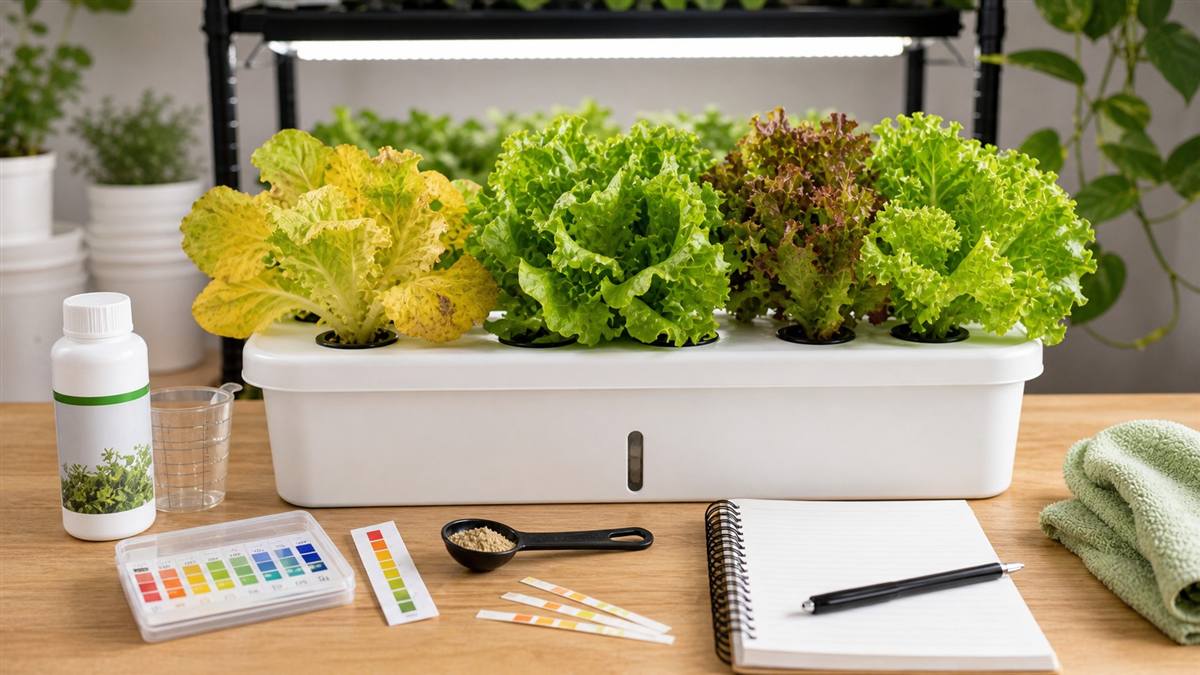
Something is wrong with your plants and you’re not sure what. The leaves are yellowing, or the roots look brown and slimy, or everything just seems… stunted. You’ve done everything right — or so you thought.
Here’s the reassuring truth: almost every problem that shows up in a hydroponic system has a clear cause and a straightforward fix. Unlike soil gardening, where diagnosing problems can feel like guesswork, hydroponics gives you direct control over every variable — which means when something goes wrong, you can usually identify exactly why and correct it within a day or two.
This guide covers the most common hydroponic problems, how to diagnose them accurately, and what to do to get your system back on track.
Table of Contents
- Diagnose Before You Act
- Yellow Leaves
- Root Rot and Slimy Roots
- Algae in the Reservoir
- Slow or Stunted Growth
- Wilting Despite Full Reservoir
- Tip Burn on Lettuce
- Brown Leaf Tips and Edges
- Leggy, Stretched Seedlings
- pH Keeps Swinging
- Pests in an Indoor System
- Prevention: The 5-Minute Weekly Check
- Frequently Asked Questions
Diagnose Before You Act
The most common mistake when something goes wrong in a hydroponic system is reacting immediately — dumping in more nutrients, changing the water, adding supplements. This often makes things worse by masking the real problem or introducing new variables.
Before you do anything, check these three things in order:
- pH — Test it right now. Write it down. More than 80% of visible plant problems in hydroponics trace back to pH being out of range, not to a missing nutrient or a system failure.
- Water level — Is the reservoir full enough? Is it too full (preventing the air gap in a Kratky system)?
- Light — Is the grow light working? Is it close enough? Has anything blocked it?
If all three are fine, then you dig deeper into the specific symptom. Let’s go through them one by one.
Yellow Leaves
Yellowing is the most common thing beginners worry about — and the most commonly misdiagnosed. The pattern of yellowing tells you a lot about what’s actually happening.
Yellowing Starts on Older (Lower) Leaves
Most likely cause: Nitrogen deficiency or pH lockout.
Nitrogen is a mobile nutrient — when a plant is deficient, it pulls nitrogen from older leaves to feed new growth. You’ll see yellowing start at the bottom of the plant and move upward.
Before assuming you need more nitrogen, check your pH. If pH is above 7.0, nitrogen becomes chemically locked and unavailable even if it’s present in the solution. Fix the pH first, wait 48 hours, and watch whether the yellowing stops progressing.
Fix: Adjust pH to 5.8–6.2. If pH was already correct, increase your nutrient concentration slightly (raise EC by 0.2–0.3).
Yellowing Between Veins on Older Leaves (Veins Stay Green)
Most likely cause: Magnesium deficiency.
This pattern — called interveinal chlorosis — is a classic magnesium deficiency signature. Magnesium is central to chlorophyll production, so when it’s lacking, the tissue between leaf veins loses its green color while the veins themselves stay green.
Fix: Add a small amount of Epsom salt (magnesium sulfate) to your reservoir — start with ½ teaspoon per gallon. Also check pH, as magnesium is most available between 6.0 and 6.5.
Yellowing Between Veins on New (Upper) Leaves
Most likely cause: Iron deficiency — almost always caused by pH being too high.
Iron is an immobile nutrient, so deficiency shows up in new growth first. Iron becomes unavailable above pH 6.5. This is one of the clearest signs that your pH has drifted upward.
Fix: Lower pH to 5.8–6.0 using pH Down solution. Don’t add iron supplements until you’ve corrected pH — they won’t be absorbed anyway.
Overall Pale, Washed-Out Color
Most likely cause: Nutrient solution too weak (low EC) or inadequate light.
Fix: Check EC/PPM — if it’s below 0.8 for leafy greens, mix a fresh batch at a slightly higher concentration. If EC is fine, assess your light — pale plants without yellowing are often just light-starved.
Root Rot and Slimy Roots
Healthy hydroponic roots are white or off-white and slightly fuzzy-looking (those fine root hairs are a good sign). Brown, slimy roots with an unpleasant smell indicate root rot — a fungal infection caused by the pathogen Pythium.
Causes of Root Rot
- Light reaching the reservoir — This is the #1 cause. Any light penetrating your container warms the water and triggers algae and Pythium growth.
- Water temperature too warm — Pythium thrives above 72°F. Ideal reservoir temperature is 65–68°F.
- Insufficient oxygen at roots — More relevant to active systems; in Kratky, ensure the air gap is forming properly.
- Stagnant, unchanged water — In active systems, water that sits too long without a reservoir change accumulates pathogens.
How to Fix Root Rot
- Remove the plant and gently rinse roots in clean, pH-adjusted water
- Trim away severely affected (black, mushy) root sections with clean scissors
- Empty and thoroughly clean the reservoir with a dilute hydrogen peroxide solution (3% H2O2, 1 part to 10 parts water)
- Refill with fresh nutrient solution at correct pH
- Block ALL light from reaching the reservoir — seal gaps around net pots, ensure the container is fully opaque
- Consider adding a small air pump and airstone to increase dissolved oxygen if you’re running a passive system and seeing repeat issues
Caught early, plants often recover fully. Caught late (roots are more brown than white), recovery is less certain but still worth attempting.
Algae in the Reservoir
Green or brown algae growing in your reservoir is frustrating but not immediately fatal to your plants. It does compete for nutrients and oxygen, however, and it signals a problem you need to fix to prevent root rot down the line.
Cause: Light reaching the nutrient solution. Always. Algae needs light to grow — no light, no algae.
Fix:
- Cover all gaps around net pots — use aluminum foil, black tape, or cut foam to seal them
- If your container is translucent, paint the outside black or wrap it in black plastic
- Do a full reservoir clean and refill with fresh solution
- Check for cracks or gaps in the lid or container walls letting light through
Once you’ve blocked all light, algae will not return. This is a fixable, preventable problem.
Slow or Stunted Growth
If your plants are alive but barely growing — small, slow, and underwhelming — work through this checklist:
| Possible Cause | How to Check | Fix |
|---|---|---|
| pH out of range | Test pH — should be 5.5–6.5 | Adjust to 5.8–6.2 |
| Nutrients too weak | Test EC — should be 0.8–1.6 for leafy greens | Mix fresh solution at slightly higher concentration |
| Insufficient light | Is the grow light close enough? Working? | Lower light to 8–10 inches above canopy; check bulb |
| Temperature too cold | Is the room below 60°F? | Move to a warmer location; most greens prefer 65–75°F |
| Seedlings too young | How long since germination? | Patience — the first 1–2 weeks are slow; growth accelerates |
| Wrong light schedule | Is your timer set correctly? | Set to 14–16 hours on for leafy greens |
The most common culprit for slow growth, in my experience, is light — either too far away, too few hours, or a cheap light that doesn’t deliver what its packaging claims. If you’re using a grow light and growth is disappointingly slow, try lowering it or running it longer before changing anything else.
Wilting Despite Full Reservoir
This one is counterintuitive and alarming: your reservoir is full, but your plant is wilting as if it has no water. Two likely causes:
No Air Gap (Kratky Systems)
In a Kratky system, if you’ve been topping up the reservoir constantly and the water level has never dropped, the roots have been fully submerged with no oxygen. They suffocate and lose the ability to transport water to the plant — hence wilting despite wet roots.
Fix: Lower the water level by removing some solution until the bottom of the net pot has 1–2 inches of air gap. Let the plant recover over 24–48 hours. If the roots have already rotted, treat as root rot above.
Root Rot (Advanced)
If root rot has progressed to the point where most of the root system is compromised, the plant cannot uptake water even if it’s surrounded by it. Check roots for browning and sliminess. Treat as described in the root rot section above.
Tip Burn on Lettuce
Tip burn is the browning of leaf edges and tips on inner lettuce leaves — not to be confused with the outer leaf browning caused by nutrient burn. It’s one of the most common issues specifically with hydroponic lettuce, and it has a specific cause.
Cause: Calcium deficiency at the leaf tips, caused by poor internal water movement — not necessarily a lack of calcium in the solution. Fast-growing inner leaves don’t receive enough calcium because transpiration (water movement through the plant) is low in those sheltered inner leaves.
Fixes:
- Add a small fan — gentle airflow increases transpiration and calcium uptake dramatically. This is the most effective single fix for tip burn.
- Check calcium in your nutrient formula — ensure your formula includes calcium (most complete formulas do; single-part powders sometimes don’t)
- Lower nutrient concentration slightly — very high EC can worsen tip burn by reducing water uptake
- Choose tip-burn resistant varieties — ‘Buttercrunch’ and ‘Nevada’ lettuce varieties are notably more resistant than loose-leaf types
Brown Leaf Tips and Edges
Brown tips on outer leaves — especially if accompanied by a slight curling — typically indicate nutrient burn: the nutrient concentration is too high and salts are accumulating at leaf edges where water evaporates.
Fix: Check EC. If it’s above 2.0 for leafy greens, your solution is too strong. Do a partial or full reservoir change with fresh solution at a lower concentration. Water your plants with pH-adjusted plain water once to flush salt buildup from the growing medium.
Leggy, Stretched Seedlings
Seedlings stretching tall with long gaps between leaves (called etiolation) are reaching desperately for light. This isn’t a nutrient problem — it’s purely a light problem.
Fix: Move your grow light closer to the seedlings — start at 6–8 inches above the canopy. Increase the light duration to 16 hours. If you’re relying on a window, move to a brighter location or add a grow light. Leggy seedlings can recover once they get adequate light, though they may remain slightly weaker than well-lit plants.
pH Keeps Swinging
If you’re finding that pH drifts significantly between checks — jumping up or down by more than 0.5 per day — a few things could be happening:
- Algae growth — Algae dramatically affects pH, causing it to rise during daylight hours and drop overnight. Fix the light leak causing algae and pH will stabilize.
- Plants actively drinking and changing the solution chemistry — Normal and expected, especially in the first few weeks of growth. Check every 2–3 days and adjust as needed.
- Reservoir too small for the plant size — A small reservoir with large, thirsty plants will swing in pH and EC quickly. Scale up your reservoir or change solution more frequently.
- Tap water with high alkalinity — Some tap water has a high carbonate buffer that fights pH adjustment. Use filtered water or let tap water sit 24+ hours before using.
Pests in an Indoor System
One of the advantages of indoor hydroponics is that outdoor pests can’t reach your plants. But a few problems can still appear indoors:
Fungus Gnats
These tiny flies are attracted to moist growing medium. They’re mostly a nuisance, but larvae can damage roots. They most often appear when growing medium stays excessively wet near the surface.
Fix: Let the top layer of growing medium dry out slightly between checks. Yellow sticky traps catch adults. A layer of sand on top of clay pebbles prevents larvae from reaching roots.
Spider Mites
Tiny mites that cause stippled, silvery leaf damage. They thrive in hot, dry conditions. Check the undersides of leaves for tiny moving dots or fine webbing.
Fix: Increase humidity, lower temperature. Wipe leaves with a damp cloth. For serious infestations, neem oil spray (diluted per instructions) applied to leaves works well. Keep affected plants isolated from healthy ones.
Aphids
Small soft-bodied insects that cluster on new growth and undersides of leaves. They can spread quickly.
Fix: A strong stream of water to knock them off, followed by neem oil spray. Introduce them from outside (on new plants or tools) — always inspect anything coming into your growing space.
Prevention: The 5-Minute Weekly Check
Most of the problems in this guide are caught and fixed easily when you check your system regularly. Here’s the quick routine that prevents 90% of issues from becoming serious:
- Check pH — 2 minutes. Adjust if outside 5.5–6.5.
- Check water level — 30 seconds. Top up with fresh nutrient solution if low.
- Look at roots — 30 seconds. Peek through a net pot. White and healthy? Good. Any browning? Act early.
- Scan leaves — 1 minute. Any yellowing, spots, or tip burn starting? Note it and monitor.
- Check the light — 30 seconds. Is it on? Is it the right distance from the canopy?
That’s it. Five minutes, done. Problems caught at this stage are almost always minor and easy to fix. Problems ignored for two weeks can mean losing a crop.
If you’re just getting started and want to make sure your system is set up to avoid these issues from the beginning, the complete DIY hydroponics guide walks through setup from scratch, and the hydroponic nutrients guide covers getting your solution right from the first mix. And if you’re growing with a Kratky passive system, the most important prevention tip is the simplest: block all light from your reservoir and let the air gap form naturally.
Once you’re past the first few grows and your system is running consistently, most of these issues fade away entirely. The learning curve in hydroponics is real — but it’s short.
If your goal is to get to the point where your system produces enough to feed your family and sell the surplus to neighbors, the Indoor Mini Farm System shows you exactly how to get there.
Frequently Asked Questions
Why are my hydroponic plants turning yellow?
The most common cause is pH being out of the 5.5–6.5 range, which locks nutrients out of the plant even if they’re present in the water. Check pH first. If pH is correct, look at the pattern of yellowing — older leaves yellowing first suggests nitrogen deficiency or lockout; yellowing between veins on new growth suggests iron or magnesium issues.
What causes root rot in hydroponics?
Root rot (Pythium) is almost always caused by light reaching the nutrient solution, which warms it and triggers pathogen growth, or by reservoir water that’s too warm (above 72°F). Insufficient oxygen at the roots is a secondary cause, especially in active systems where the pump fails. Block all light from your reservoir and keep water temperatures cool to prevent it.
Why is my hydroponic system growing algae?
Algae needs light and nutrients to grow. If algae is appearing in your reservoir, light is reaching your nutrient solution somewhere. Check for translucent container walls, gaps around net pots, and cracks in the lid. Block all light access and algae will not return.
Why are my hydroponic plants growing slowly?
The most common causes are insufficient light, pH out of range, or nutrient solution that’s too weak. Check all three before changing anything. Most slow-growth problems in beginner setups trace back to a grow light that’s either too far away, running too few hours, or simply underpowered for the growing area.
How do I fix tip burn on hydroponic lettuce?
Add a small fan to improve airflow over the canopy — this is the single most effective fix for tip burn. Gentle air movement increases transpiration in the inner leaves, improving calcium uptake. Also check that your nutrient formula includes calcium, and consider switching to a tip-burn resistant variety like Buttercrunch for future grows.
Can I save a plant with root rot?
Often yes, if caught early. Remove the plant, rinse the roots, trim the worst-affected sections, clean the reservoir with dilute hydrogen peroxide, refill with fresh nutrient solution, and block all light from reaching the water. Plants with some healthy white roots remaining often recover fully within a week or two.
Every hydroponic grower runs into these problems at some point. The ones who stick with it learn that the fixes are almost always simple — and that a system running well is genuinely low-maintenance. If you’re ready to build a setup that produces consistently, the Indoor Mini Farm System is the complete guide to getting there.