Most people start homesteading to reduce what they spend. At some point — usually after the first surplus harvest — they start wondering whether they could also make money from it. The answer, for many homesteaders, is yes. Sometimes surprisingly well.
The key is choosing income streams that match your scale, your skills, and how much time you actually have. Not every homestead income idea works for every setup. But there are a handful of models that work consistently for small-scale growers — and one in particular that works exceptionally well even without land, a market booth, or a large customer base.
This guide covers the most practical ways to make money homesteading in 2026 — what they require, what they realistically earn, and how to think about which ones fit your situation.
Table of Contents
- The Principles of Profitable Homesteading
- Indoor Growing: The Highest-Return Starting Point
- Farmers Markets
- Eggs and Poultry
- Fresh Herbs
- Value-Added Products
- Teaching and Content
- Selling Seedlings and Starts
- CSA and Subscription Models
- Income Stream Comparison
- Frequently Asked Questions
The Principles of Profitable Homesteading
Before diving into specific income streams, a few principles separate homesteaders who build reliable income from those who stay perpetually busy without much to show for it.
Sell high-value, perishable products. The most profitable homestead products are things that are expensive to buy, don’t last long, and are hard to ship. Fresh herbs, living plants, eggs, and artisan foods all fit this profile. Dried beans and bulk grains don’t — they’re competing with industrial-scale producers.
Minimize your labor per dollar earned. Harvesting individual lettuce leaves and selling them by the pound is labor-intensive for modest return. Selling an entire living plant that the customer harvests themselves is faster, commands a higher price, and builds repeat business. Always ask: is there a way to sell the same product with less processing?
Build recurring customers, not one-time sales. A neighbor who buys a living lettuce tote from you every six weeks is worth far more than a stranger who buys once at a farmers market. Build relationships with a small number of consistent customers before chasing volume.
Start with one income stream, do it well. The homesteaders who burn out fastest are the ones who try to sell eggs, herbs, seedlings, jam, and honey simultaneously in year one. Master one product first. Expand from a position of proven success.
Indoor Growing: The Highest-Return Starting Point
If you’re looking for the highest return on investment, the lowest startup cost, and the most consistent year-round income from a homestead operation, indoor hydroponic growing of living plants checks every box.
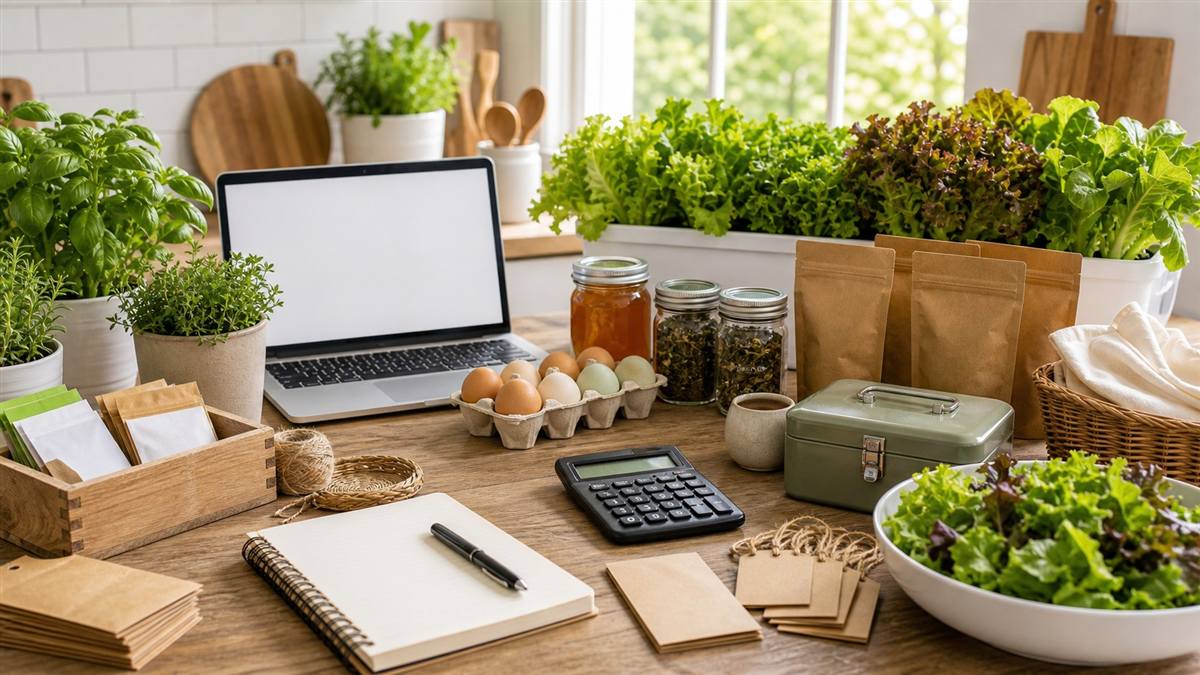
Here’s the model: you grow full-size leafy greens — lettuce, kale, spinach, basil — in simple hydroponic totes using the Kratky passive method. Instead of harvesting and selling cut greens (labor-intensive, short shelf life), you sell the entire living tote to neighbors. They take it home, keep it on a windowsill, and harvest from it for weeks. You replant immediately and start the next cycle.
A ready-to-harvest living lettuce tote sells for $30–$50. Your cost to produce it — seeds, nutrients, electricity — is $2–$4. The time to set it up and maintain it is about 10–15 minutes per tote per week. Run three totes a week and you’re looking at $360–$600/month from a shelf in a spare room, working about an hour per week.
For a full breakdown of the economics and how to find your first buyers, see growing greens for profit and the hydroponic lettuce business guide. The complete growing system is covered in the Indoor Mini Farm System.
Farmers Markets
Farmers markets are the most visible homestead income channel — and one of the more demanding ones. Booth fees run $20–$100 per market depending on location. You need to be there every week (or most weeks) to build a customer base. Setup, transport, and teardown add 4–6 hours to every market day beyond actual selling time.
That said, farmers markets are excellent for specific products: fresh herbs, specialty greens, value-added items like jams and pickles, eggs, and cut flowers. High-margin, eye-catching products that sell themselves at a booth. A well-stocked herb table at a Saturday market can generate $150–$400 in a few hours from the right location.
For a complete guide to selling at farmers markets — including what sells best, how to price, and how to get accepted into your local market — that post covers the full process.
Eggs and Poultry
Backyard eggs sell easily and command premium prices — $6–$12 per dozen for genuine pasture-raised eggs in most markets. Six to eight hens produce enough eggs to supply your family and sell 2–3 dozen per week to neighbors. Net profit after feed costs: typically $30–$60/month for a small flock.
Eggs work best as a supplementary income stream. The hens produce manure for compost, eat garden pests, and provide better eggs than anything at retail. The income is a bonus rather than the primary reason to keep chickens.
Fresh Herbs
Fresh herbs are the most underrated homestead income opportunity. They’re expensive at the grocery store ($3–$5 per small bunch), have an extremely short shelf life, and grow prolifically indoors year-round under grow lights.
The indoor growing advantage is significant: while outdoor herb production is seasonal, an indoor hydroponic shelf produces continuous basil, cilantro, and mint every month. For a detailed breakdown of the best herbs to sell and how to price them, see the herb selling guide.
Value-Added Products
Value-added products transform raw homestead produce into something with higher margins and longer shelf life. A pound of cucumbers sells for $1–$2; a jar of artisan pickles sells for $8–$12. Common high-margin products: jams, pickles, ferments, dried herb blends, hot sauce, infused oils.
Note: cottage food laws govern what you can legally sell from a home kitchen, and they vary significantly by state — some are permissive, others are quite restrictive. See the guide to selling produce from home for the general legal landscape, and verify the rules for your specific location before starting.
Teaching and Content
Once you’ve built a working homestead system, the knowledge you’ve accumulated has value. In-person workshops (6–10 people at $50–$100/person), online courses, YouTube or blog content, and one-on-one consulting ($75–$150/hour) all convert experience into income — often with better margins than the growing operation itself.
Selling Seedlings and Starts
In spring, demand for vegetable and herb transplants dramatically outstrips supply. Tomato starts sell for $3–$6 each; heirloom varieties for $5–$8. A 72-cell tray costs pennies per cell and produces $200–$400 in saleable transplants. Spring plant sales can generate $500–$2,000 in a single weekend from a modest seed-starting setup.
CSA and Subscription Models
A CSA provides reliable income and working capital before the season starts. For indoor growing operations, a monthly subscription works even better: customers pay monthly for a regular delivery of living plants or fresh herbs, you know exactly how much to grow each week, and a subscription of 10 customers at $40/month is $400/month with almost no ongoing marketing effort.
For a detailed look at structuring a small CSA, the CSA business plan guide walks through share pricing, member acquisition, and weekly operations.
Income Stream Comparison
| Income Stream | Startup Cost | Monthly Earning Potential | Hours/Week | Year-Round? |
|---|---|---|---|---|
| Indoor living plant sales | $50–$200 | $200–$800 | 3–5 hrs | Yes |
| Fresh herbs (indoor) | $50–$150 | $100–$400 | 2–3 hrs | Yes |
| Farmers market (produce) | $200–$500 | $300–$1,200 | 8–12 hrs | Seasonal |
| Backyard eggs | $500–$1,500 | $40–$100 (net) | 1–2 hrs/day | Yes |
| Spring seedling sales | $100–$300 | $500–$2,000 (one season) | Variable | Seasonal |
| Value-added products | $200–$800 | $200–$600 | 4–8 hrs | Seasonal |
| Workshops/teaching | Minimal | $200–$800/event | Variable | Yes |
| CSA subscription | $200–$500 | $400–$1,500 | 8–15 hrs | Seasonal/Year-round |
Frequently Asked Questions
Can you actually make money homesteading?
Yes. Many small-scale homesteaders generate meaningful supplemental income, and some build full-time livelihoods from it. The key is choosing income streams with favorable economics — high-value products, low labor per sale, recurring customers — rather than trying to compete with commercial producers on volume.
What is the most profitable thing to grow on a small homestead?
Fresh herbs and living lettuce plants grown hydroponically indoors consistently deliver the highest profit per square foot and per hour of labor. Low production cost, high selling price, year-round availability, and recurring customer demand make indoor growing the most reliably profitable homestead income stream at small scale.
How much can a small homestead make per year?
A small homestead with one or two well-chosen income streams can reasonably generate $5,000–$20,000 per year in supplemental income. Indoor living plant operations running year-round generate $2,400–$9,600 annually from minimal infrastructure. Adding farmers market sales, seedling sales, or value-added products expands that range significantly.
Do I need a license to sell produce from home?
Requirements vary by state and by what you’re selling. Don’t assume — check the rules for your specific location before you start. The guide to selling produce from home covers the general legal landscape and where to find the authoritative answers for your area.
Ready to choose your first income stream and build a plan around it? 25 Proven Ways to Make Money from Your Homestead gives you all 25 income models ranked and explained, plus a printable action checklist so you can pick the right one for your situation and start this week.