Most gardeners put the garden to bed in October and don’t think about it again until March. That’s five months of buying everything from the grocery store — five months of gap in what could be a year-round food production system.
Winter gardening isn’t about fighting the cold to grow tomatoes in January. It’s about understanding which crops thrive in cool and even cold conditions, using simple structures to extend those crops further, and — for the months when outdoor growing genuinely isn’t possible — having an indoor system that doesn’t stop just because it’s cold outside.
Here’s what actually works for growing food through winter, organized from the simplest techniques to the more involved.
Table of Contents
- Cold-Hardy Crops That Grow Through Winter
- Row Cover: The Cheapest Season Extender
- Cold Frames: A Step Up in Protection
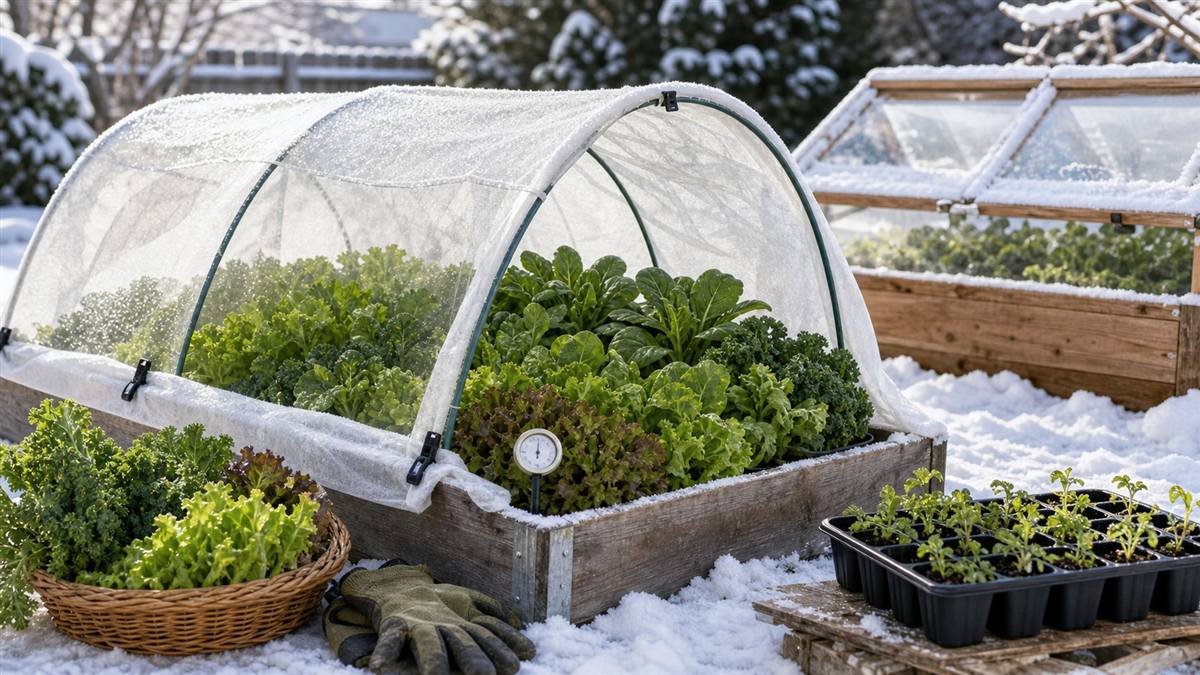
- Low Tunnels and Hoop Houses
- Heavy Mulching for Root Crop Overwintering
- Indoor Growing: The Real Winter Solution
- Winter Growing Calendar
- Frequently Asked Questions
Cold-Hardy Crops That Grow Through Winter
Before you invest in any season extension structure, understand what can survive winter outdoors in your climate without protection. More crops handle cold than most gardeners realize — and many of them actually taste better after frost.
Crops That Survive Hard Frost (Below 28°F)
- Kale — The most cold-hardy common vegetable. Many varieties survive temperatures well below 20°F. Flavor improves dramatically after frost — the plant converts starches to sugars as a cold protection mechanism. A kale harvest in January is often the sweetest of the year.
- Collard greens — Even hardier than kale. A staple of winter gardens in the American South, collards handle repeated freezing and thawing without damage.
- Brussels sprouts — Planted in summer, harvested in fall and through winter. Frost improves flavor. One of the best long-season cold-weather crops.
- Parsnips and carrots — Left in the ground through frost, these root vegetables become sweeter. In many climates you can harvest directly from frozen ground through winter. Heavy mulching keeps the soil workable longer.
- Garlic — Planted in fall, overwinters in the ground, harvested the following summer. Fully frost-hardy.
- Overwintering onion sets — Planted in fall, produce early-spring onions before anything else is growing.
Crops That Handle Light Frost (28–32°F)
- Spinach — Hardy to around 20°F with some protection. Can be sown in fall for overwintering in mild climates (zones 6+). Survives light snow and emerges in early spring.
- Arugula — Surprisingly cold-tolerant. Grows slowly through winter under row cover and picks up speed as days lengthen in late winter.
- Claytonia (miner’s lettuce) — One of the most cold-hardy salad crops available. Grows through winter in most zones with minimal protection.
- Mâche (corn salad) — Specifically bred for winter growing. Germinates in cold, grows slowly all winter, and is ready to harvest in early spring. Mild, nutty flavor.
- Swiss chard — Hardy to around 25°F. May die back in hard freezes but often regrows from the root when temperatures moderate.
The Frost Sweetening Effect
Many cold-hardy crops taste significantly better after frost exposure. Kale, Brussels sprouts, parsnips, carrots, and collards all convert starches to sugars when temperatures drop — a natural antifreeze mechanism that makes them noticeably sweeter. A November harvest of frost-kissed kale is genuinely different from the same plant harvested in August. This is one of the underappreciated pleasures of winter gardening.
Row Cover: The Cheapest Season Extender
Floating row cover — lightweight spunbonded fabric draped directly over plants — is the single most cost-effective season extension tool available. It admits light and water while trapping warmth from the soil, typically adding 4–8°F of frost protection depending on the weight used.
Row Cover Weights
- Lightweight (0.5–0.9 oz/sq yd) — Primarily for pest exclusion and light frost protection (to about 28°F). Transmits 85–95% of light. Suitable for spring and fall use.
- Medium weight (1.0–1.5 oz/sq yd) — Protection to about 24–26°F. Good all-purpose winter cover. Transmits 70–85% of light.
- Heavy weight (2.0 oz/sq yd) — Protection to about 20°F. Transmits less light (30–50%) so best for short periods or crops that tolerate low light.
How to Use Row Cover
Drape directly over plants and secure edges with soil, rocks, or landscape staples. For taller crops, use wire hoops (made from 9-gauge wire bent into arches) to keep fabric off plants — fabric touching plants transmits cold more readily than fabric held above them. A roll of row cover ($10–$20) handles a full 4×8 bed and lasts multiple seasons.
Remove on warm days (above 40°F) to prevent overheating under heavy cover. Lightweight cover can stay on continuously — it’s breathable and won’t overheat plants even on mild winter days.
Cold Frames: A Step Up in Protection
A cold frame is essentially a bottomless box with a transparent lid — a mini greenhouse that sits directly on the garden bed. It captures solar heat during the day and releases it slowly at night, creating a microclimate that’s typically 10–15°F warmer than outside air temperatures.
In zone 6 (where winter lows regularly reach 0–10°F), a well-built cold frame extends the growing season by 4–6 weeks in both spring and fall, and allows cold-hardy crops like spinach, mâche, and arugula to survive through most of winter.
Simple Cold Frame Build
The simplest cold frame uses a salvaged storm window or old glass door as the lid, supported by four boards forming a rectangular box. The back should be taller than the front (angling the lid toward the south to capture more winter sun). A 4×4 ft cold frame with an old window lid costs almost nothing to build and dramatically extends your season.
Prop the lid open on warm days to prevent overheating — temperatures inside a cold frame can spike rapidly on sunny winter days even when outside air is cold. A simple stick prop works fine.
What to Grow in a Cold Frame
- Spinach — sow in fall, overwinter in cold frame, harvest through winter and early spring
- Mâche and claytonia — specifically bred for cold frame winter production
- Arugula — grows slowly through winter, more productive than outdoors
- Lettuce — survives milder winters (zones 7+) in a cold frame; marginal in colder zones
- Kale and chard transplants — protection from the worst cold extends harvest
Low Tunnels and Hoop Houses
A low tunnel is a row cover or plastic film stretched over wire hoops — a step up from draping fabric directly on plants. It creates a more structured microclimate and makes it easier to vent on warm days by simply rolling up one side.
A hoop house (also called a high tunnel) is the larger version — tall enough to walk in, covering a full bed or section of garden. It’s the most effective season extension structure short of a full greenhouse, and can be built for $200–$500 for a 10×20 ft structure using EMT conduit and greenhouse plastic.
What Hoop Houses Enable
- Zone 5–6: Year-round cold-hardy greens; tomatoes and peppers 4–6 weeks earlier in spring and later in fall
- Zone 7–8: Near year-round outdoor vegetable production; winter lettuce, spinach, and herbs without supplemental heat
- Zone 9–10: Essentially year-round growing for all crops including warm-season vegetables
A hoop house is a significant investment — both in cost and in time to build — but the payoff in growing season extension is substantial. For serious homesteaders in cold climates, it’s often the single most impactful infrastructure addition after the basic garden beds are established.
Heavy Mulching for Root Crop Overwintering
Many root crops can be left in the ground through winter and harvested as needed — a living root cellar that requires no infrastructure beyond a thick layer of mulch. This works particularly well for:
- Carrots — Cover with 6–12 inches of straw mulch after the ground begins to freeze. Harvest directly from under the mulch through winter. Flavor improves continuously with cold exposure.
- Parsnips — Even more cold-tolerant than carrots. Leave in ground all winter; harvest in early spring after frost sweetening. Some growers leave them until after the first spring thaw for maximum sweetness.
- Beets — Hardy to about 25°F. Cover with mulch for deeper cold. Harvest until the ground freezes solid.
- Jerusalem artichokes — Extremely cold-hardy tubers. Leave in the ground, harvest as needed through winter wherever the ground isn’t frozen solid.
Indoor Growing: The Real Winter Solution
All of the techniques above extend your outdoor season — they don’t replace it when temperatures drop below what even cold-hardy crops can handle. In zones 5 and colder, there are genuinely months where outdoor growing stops entirely regardless of how many cold frames you have. That’s when indoor growing becomes not just convenient but essential.
A simple indoor hydroponic setup — a shelf with LED grow lights and one or two passive growing totes — produces fresh lettuce, herbs, kale, spinach, and arugula in January just as readily as in July. It runs completely independent of outdoor conditions, costs $4–$10 per month to operate, and requires about 30 minutes of attention per week.
This isn’t a seasonal supplement — it’s a parallel system that runs 12 months a year. Combined with outdoor cold-frame growing and preserved summer produce, it closes the winter gap that makes “year-round food production” feel unachievable for most northern-climate gardeners.
The Kratky method is the simplest indoor starting point: no pump, no electricity beyond a grow light, no complexity. The complete DIY hydroponics guide covers all system options and costs. And for the full picture of how an indoor system integrates with an outdoor garden across all four seasons, the year-round vegetable garden plan maps it all out.
Winter Growing Calendar
| Crop | Plant/Sow | Method | Harvest Window |
|---|---|---|---|
| Garlic | October | In-ground | Following July |
| Overwintering onion sets | October | In-ground | March–April |
| Spinach (overwintering) | August–September | Cold frame or row cover | November–April |
| Mâche | September–October | Cold frame | December–March |
| Arugula | September | Cold frame or row cover | November–February |
| Kale | July–August (transplant) | Outdoors (very cold-hardy) | November–February |
| Carrots (overwintering) | Summer | In-ground under heavy mulch | November–February |
| Lettuce (indoor hydroponic) | Any time | Indoor grow light | 30–45 days after sowing, continuous |
| Herbs (indoor hydroponic) | Any time | Indoor grow light | 28–35 days after sowing, continuous |
If you’re ready to build the indoor piece that makes this calendar work through the coldest months, the Indoor Mini Farm System is the complete guide to getting it running — from setup through to harvesting consistently every week of the year.
Frequently Asked Questions
What vegetables can you grow in winter outdoors?
Kale, collard greens, and Brussels sprouts are the hardiest, surviving temperatures well below 20°F. Spinach, arugula, mâche, and claytonia survive light to moderate frost with or without protection. Carrots and parsnips can be left in the ground under heavy mulch through most northern winters. The colder your climate, the more you’ll rely on cold frames, row cover, and indoor growing to extend your season.
Do vegetables taste different after frost?
Many do — and better. Kale, Brussels sprouts, parsnips, carrots, and collards all convert starches to sugars as a cold-adaptation mechanism. Frost-sweetened kale harvested in November or December is noticeably milder and sweeter than the same variety harvested in August. This is one of the genuine pleasures of winter and fall gardening.
How do you keep a garden going in winter?
Use a combination of approaches: plant cold-hardy crops (kale, spinach, garlic) in fall for winter harvest; extend their season with row cover or a cold frame; overwinter root crops (carrots, parsnips) under heavy mulch; and run an indoor hydroponic growing system for fresh greens and herbs year-round regardless of outdoor temperatures. No single technique covers all of winter — the combination does.
Is a cold frame worth building?
Yes, for most gardeners in zones 5–8. A simple cold frame built from salvaged materials costs almost nothing and extends your outdoor season by 4–6 weeks in both spring and fall. For overwintering spinach, mâche, and arugula through winter, it’s the most cost-effective structure available. A more sophisticated hoop house extends the season further and is worth considering once you’re committed to year-round outdoor growing.
What is the easiest winter vegetable to grow?
Outdoors: kale requires the least intervention of any winter vegetable — plant it in summer, harvest through fall and winter with no protection needed in most zones. In a cold frame: mâche (corn salad) is specifically designed for winter production and requires almost no attention. Indoors: lettuce in a simple Kratky hydroponic setup is the easiest year-round crop available — 30–45 days from seed to harvest, continuous production, minimal maintenance.
Winter gardening isn’t about fighting the cold — it’s about working with it. Plant the right crops, use the right structures, and build an indoor system for the months outdoor growing genuinely can’t cover. If you’re ready to set up that indoor piece, the Indoor Mini Farm System is the complete guide to year-round food production from inside your home.