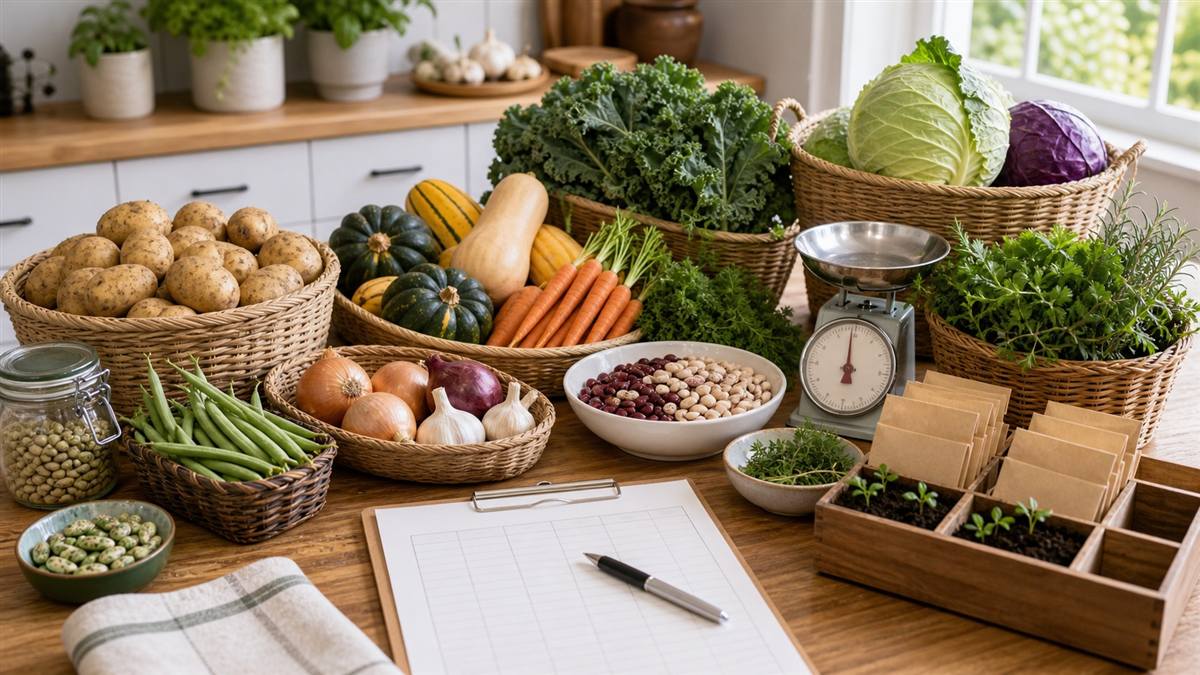
Self-sufficiency isn’t about growing everything — it’s about growing the right things. The crops that make the biggest difference to your actual food independence are rarely the ones that get the most attention in gardening media.
Corn looks impressive. Giant pumpkins are fun. But neither is going to meaningfully reduce your dependence on the grocery store. What will? Fast-growing leafy greens you eat every week. Herbs that cost $4 a bunch and take 30 days to grow. Tomatoes that produce 20 pounds from a single plant through the summer.
This guide cuts through the noise and focuses on the crops that genuinely move the needle — ranked by their practical value to a home grower trying to feed their family from their own land.
Table of Contents
- How to Evaluate a Crop for Self-Sufficiency
- Tier 1: Grow These First (Highest Value Per Effort)
- Tier 2: High-Value Summer Crops
- Tier 3: Calorie and Storage Crops
- Perennial Crops: Plant Once, Harvest for Years
- Crops That Aren’t Worth It for Most Home Growers
- Making Greens and Herbs Year-Round with Hydroponics
- Frequently Asked Questions
How to Evaluate a Crop for Self-Sufficiency
When deciding what to grow, I use four criteria:
- Grocery value per square foot — How much would this cost to buy, and how much can I produce per unit of growing space?
- Frequency of use — Does my family eat this every week, or occasionally? Weekly staples have the highest impact.
- Ease of growing — Does it require specialized knowledge or equipment, or can a beginner grow it reliably?
- Season length — Does it produce once a year, or continuously over a long window?
The crops that score highest on all four criteria are almost always leafy greens, herbs, and summer fruiting vegetables. Not grains, not large livestock feed crops, not exotic specialty items — the fundamentals.
Tier 1: Grow These First (Highest Value Per Effort)
Salad Greens and Lettuce
Nothing in the garden delivers faster, more consistent value than lettuce and salad greens. A head of organic lettuce costs $4–$7 at the grocery store and lasts 3–5 days in the fridge. A hydroponic tote growing six heads takes 35 days and costs about $2 in nutrients and seeds to run. The math is immediate and obvious.
The additional advantage: greens grow year-round indoors. A passive Kratky hydroponic system on a shelf produces continuous lettuce in January just as readily as in July. No other crop offers that combination of speed, value, and year-round availability. For anyone serious about food self-sufficiency, this is the first system to build.
Value per sq ft per year: $40–$100+
Time to first harvest: 30–45 days
Season: Year-round indoors; spring and fall outdoors
Fresh Herbs
Fresh herbs are the single highest value-per-square-foot crop most home growers never think of as strategic. A bunch of fresh basil at the store costs $3–$5 and wilts in four days. A single basil plant in a hydroponic system, harvested regularly by pinching the tips, produces more basil than most families can use — continuously — for months.
Multiply that across cilantro, mint, parsley, chives, dill, and thyme, and you’ve eliminated one of the most consistent weekly grocery purchases most families make. Fresh herbs are expensive precisely because they’re perishable — and growing your own solves the perishability problem entirely.
Value per sq ft per year: $60–$150+
Time to first harvest: 28–40 days
Season: Year-round indoors
Kale and Spinach
Both are cut-and-come-again crops that produce continuously when harvested regularly. Both are expensive to buy organic and used frequently by health-conscious families. Both grow exceptionally well in hydroponic systems indoors, meaning they’re available in December as easily as in June.
Kale in particular is one of the most nutritionally dense crops you can grow — and one of the most cold-tolerant outdoors, extending your outdoor season well into fall. Grow it both indoors year-round and outdoors in spring and fall for maximum output.
Value per sq ft per year: $30–$80
Time to first harvest: 40–60 days (then continuous)
Season: Year-round indoors; spring, fall, and winter outdoors in mild climates
Tier 2: High-Value Summer Crops
Cherry Tomatoes
A single cherry tomato plant in a 15-gallon container or raised bed will produce 10–20 pounds of fruit through the summer. At $4–$6 per pint at the store, that’s $40–$80 of produce from one plant. Cherry tomato varieties — especially ‘Sun Gold,’ ‘Sweet 100,’ and ‘Juliet’ — are prolific, disease-resistant, and significantly better-tasting than anything available in supermarkets.
Grow 3–4 plants for a family of four and you’ll have more tomatoes than you can eat fresh, with plenty to freeze whole for winter cooking.
Cucumbers
Cucumbers are one of the most productive crops per square foot when grown vertically. A single plant trained up a trellis produces 15–25 cucumbers through the season — more if harvested consistently every 1–2 days. They’re also excellent for preserving: a summer’s cucumber surplus becomes a year of homemade pickles.
Zucchini and Summer Squash
The most prolific vegetable in the garden — to a fault. One or two plants is genuinely sufficient for a family of four. Plant only what you can use or give away. The upside: zero effort for enormous production. The downside: you will be giving zucchini to your neighbors whether they want it or not.
Beans
Pole beans in particular are excellent for self-sufficiency — they produce over a long season, grow vertically, fix nitrogen in the soil (improving it for subsequent crops), and freeze beautifully for winter use. A 10-foot row of pole beans produces enough fresh beans for regular family meals plus a full freezer supply.
Peppers
Both sweet and hot peppers are compact, productive, and store well dried or frozen. Hot peppers are particularly efficient — a single plant produces more than most families use fresh, and dried hot peppers keep for years. Sweet peppers freeze well and are expensive to buy organic year-round.
Tier 3: Calorie and Storage Crops
These crops provide calories and long-term storage rather than fresh weekly produce. They require more space but contribute meaningfully to genuine food self-sufficiency — the ability to feed yourself through winter from what you’ve grown and preserved.
Winter Squash
Butternut, acorn, and delicata squash store for 3–6 months in a cool location with no processing required. A 4×8 raised bed or trellis system can produce 20–40 pounds of winter squash — a meaningful calorie contribution that lasts from fall harvest through the following spring.
Potatoes
One of the most calorie-dense crops per square foot available to home growers. Grow in deep raised beds, straw bales, or large containers. A 4×4 bed can produce 25–50 pounds of potatoes. Store in a cool, dark location for months. Fingerling and specialty varieties that are expensive at the store are easy to grow at home.
Garlic
Plant in October, harvest in July. Zero maintenance in between. A 4×4 bed planted with garlic cloves produces 50–80 heads — a year’s supply for most families from a single planting. Hardneck varieties store 6–8 months; softneck varieties store up to 12 months. Garlic is one of the highest grocery value-per-square-foot crops that most home growers underutilize.
Dried Beans
Grow pole or bush bean varieties specifically for dry bean production — let them fully mature and dry on the vine, then shell and store. Dried beans store for years and provide significant protein. More space-intensive than other options but contributes meaningfully to true food security.
Perennial Crops: Plant Once, Harvest for Years
Perennial food crops are among the highest long-term return investments a homesteader can make. You do the work once and harvest for years or decades. Every self-sufficiency garden should include a perennial zone.
| Crop | Years to Production | Productive Lifespan | Notes |
|---|---|---|---|
| Asparagus | 2–3 | 20+ years | Plant crowns, not seeds. Worth the wait. |
| Strawberries | 1 (partial), 2 (full) | 3–5 years per planting | Runners fill in gaps. Very high value. |
| Raspberries | 2 | 10–15 years | Produce prolifically once established. |
| Blueberries | 3–5 | 50+ years | Slow to establish, extraordinary long-term return. |
| Apple/pear trees | 3–5 (dwarf varieties) | 25–50 years | Dwarf varieties suit small spaces. |
| Perennial herbs | 1 | Indefinite | Thyme, oregano, sage, chives — plant once. |
| Rhubarb | 2 | 20+ years | Very low maintenance. Excellent for preserves. |
Crops That Aren’t Worth It for Most Home Growers
Corn — Requires large blocks for pollination, produces once per season, and takes up enormous space for relatively low grocery value. Not worth it unless you have significant land.
Melons — Space-hungry, require extended heat, and inexpensive to buy in season. The space is better used for higher-value crops.
Wheat and other grains — Possible to grow in large quantities but require significant acreage, specialized harvesting equipment, and processing infrastructure to be practical at the homestead scale. Buy grains; grow vegetables.
Celery — Notoriously difficult to grow, requires consistent moisture and a long season, and is cheap to buy. Not worth the effort for most home growers.
Making Greens and Herbs Year-Round with Hydroponics
The single biggest limitation of a self-sufficiency garden is the seasonal gap — the months when nothing is producing outdoors. In northern climates that’s 4–6 months per year. During that window, the grocery store reclaims all the ground you gained during the growing season.
Closing that gap is the highest-leverage thing most home growers can do to improve their actual food independence. And the most practical way to close it is with indoor growing — specifically, a simple hydroponic system that produces leafy greens and herbs continuously, regardless of season.
The best crops for indoor hydroponic growing — lettuce, kale, spinach, basil, cilantro, watercress, arugula — are exactly the Tier 1 crops in this guide. The same crops that are most valuable to grow are also the most suited to indoor hydroponic production. That’s not a coincidence.
Set up an indoor system running year-round alongside your outdoor garden and you’ve effectively doubled or tripled your productive season. That’s where real food self-sufficiency starts to feel achievable — and where the Indoor Mini Farm System fits in as the indoor complement to everything you’re growing outside.
Frequently Asked Questions
What crops give the best return for a self-sufficient garden?
Salad greens, fresh herbs, cherry tomatoes, cucumbers, kale, and garlic consistently deliver the highest value per square foot for self-sufficiency gardeners. These crops are expensive to buy organic, perishable (meaning you’re always buying them fresh), and productive in small spaces. Start with these before expanding to calorie crops that require more space and experience.
What vegetables should I grow to be self-sufficient?
Focus on crops your family eats every week that are expensive or perishable: salad greens, herbs, tomatoes, cucumbers, peppers, beans, and winter squash for storage. Add garlic, potatoes, and dried beans if you have space. Include an indoor growing system for year-round greens and herbs — the seasonal gap is the biggest obstacle to genuine self-sufficiency.
How much garden space do I need to feed a family?
For fresh vegetables, herbs, and some preserved surplus, a family of four can source a significant portion of their produce from 200–400 square feet of well-managed raised bed space plus an indoor growing system. Complete caloric self-sufficiency requires much more land — typically half an acre or more — but most homesteaders focus on high-value fresh crops rather than staple calories, which makes a small space genuinely meaningful.
What is the most productive food crop per square foot?
Fresh herbs and salad greens consistently rank highest in value produced per square foot — especially when grown hydroponically indoors year-round. A single square foot of hydroponic growing space can produce $40–$150 worth of herbs and greens per year. Outdoor crops with high value per square foot include cherry tomatoes, pole beans, and garlic.
Start with the high-value crops — the ones your family eats every week that cost the most to buy. Add an indoor system for year-round greens. Build outward from there. That’s the path to genuine food self-sufficiency, one harvest at a time. If you’re ready to set up the indoor piece, the Indoor Mini Farm System is the place to start.