The word “homestead” used to mean 160 acres and a covered wagon. Today it means something different — and more accessible — for most people who are drawn to it. It means intentional self-reliance. Growing some of your own food. Reducing dependence on a supply chain that seems less reliable every year. Living a little closer to where things actually come from.
You can do all of that on a quarter-acre lot. On a tenth of an acre. Even on a patio with containers and a shelf indoors. The scale is up to you. What matters is the system — starting with the pieces that give you the most return for your effort and building from there.
This is the guide I wish I’d had at the beginning: what to set up first, what to grow, how to structure your time and space, and how to think about backyard homesteading as a progression rather than an all-or-nothing commitment.
Table of Contents
- What Backyard Homesteading Actually Means
- Start With Food: The Highest-Return First Step
- Assess Your Space Honestly
- First Projects: What to Set Up in Year One
- Don’t Overlook Indoor Growing
- Year Two and Beyond: Expanding Intelligently
- Common Backyard Homestead Mistakes
- Being Realistic About Time
- Frequently Asked Questions
What Backyard Homesteading Actually Means
Backyard homesteading is the practice of using your available space — whatever that is — to produce food, reduce waste, and increase self-reliance. It’s not about being completely off-grid or feeding yourself entirely from your property. It’s about shifting the needle from full dependence on the grocery store toward something more balanced and intentional.
What that looks like in practice varies enormously. For some people it’s a productive vegetable garden and an herb shelf indoors. For others it’s chickens, fruit trees, a large vegetable garden, a root cellar, and a chest freezer full of preserved summer produce. Both are homesteading. Neither is wrong.
The key principle: start with what gives you the most return for the least complexity, build skills and systems gradually, and expand only when what you have is running well.
Start With Food: The Highest-Return First Step
New homesteaders often want to do everything at once — chickens, bees, fruit trees, a large garden, composting, rainwater collection. The result is usually overwhelm, half-finished projects, and abandonment within a year.
The better approach: start with food growing, specifically the crops that give you the fastest feedback and highest grocery savings for the effort involved. That means leafy greens, herbs, and summer vegetables — not grain crops, not large livestock, not complex preservation projects.
Here’s why this order matters: growing food teaches you the fundamentals of working with plants, seasons, and your specific microclimate. That knowledge transfers to everything else you add later. Chickens are easier to manage when you already have composting infrastructure. Fruit trees integrate naturally into a space you’ve already mapped and understood. Start with the garden — everything else builds on it.
Assess Your Space Honestly
Before you build or plant anything, spend a few weeks observing your space. Where does full sun hit, and for how long? Where does water pool after rain? Which areas are shaded by the house or neighboring trees at different times of day?
This observation period is one of the most valuable investments you can make. Gardens planted in the wrong spot fail regardless of how much work you put into them. Knowing your space well before committing to a layout saves enormous time and frustration.
What to Look For
- Full sun zones (6–8+ hours of direct sun) — your primary vegetable growing areas
- Partial sun zones (4–6 hours) — good for cool-season greens, herbs, some fruits
- Shade zones — compost bins, storage, maybe chickens or rabbits eventually
- Water access — where are your outdoor taps? Long hose runs are friction you’ll resent by August.
- Wind exposure — exposed areas need windbreaks for tall crops; sheltered spots are warmer and extend your season
- Existing trees and perennials — these define your space permanently; work with them rather than planning around their removal
First Projects: What to Set Up in Year One
A productive first year on a backyard homestead focuses on three things: soil, growing infrastructure, and a reliable harvest. Here’s what I’d prioritize in order.
1. Compost System
Set this up first, even before you plant anything. Compost is the foundation of productive soil, and it takes time — the pile you start now feeds the garden you’ll expand next year. A simple two-bin system (one actively building, one finishing) handles a household’s kitchen and yard waste and produces rich compost with minimal effort.
If you don’t have space for an outdoor compost system, a small vermicomposting bin (worm composting) works indoors or in a garage — no smell, very little space, and exceptional compost output from kitchen scraps.
2. Raised Beds or In-Ground Beds
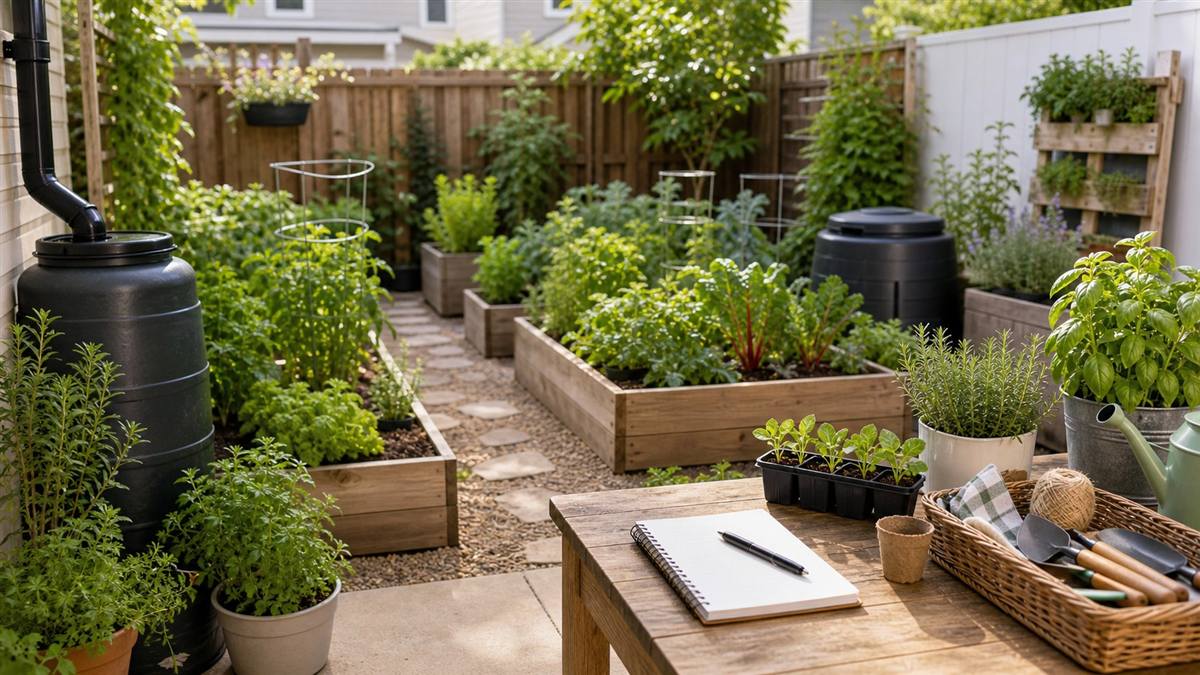
Two 4×8 ft raised beds is an excellent starting point — enough to grow a meaningful quantity of food without being overwhelming to manage. Raised beds warm up earlier in spring, drain better than most native soil, and can be intensively planted without wasted walkway space.
Fill with a mix of quality topsoil, compost, and perlite or coarse sand for drainage. Build with untreated cedar (naturally rot-resistant), pine (cheap, shorter-lived), or composite lumber. First-year cost for two beds, filled: $100–$250 depending on materials.
3. Perennial Plantings
Plant perennials in year one so they’re productive by year two and three. Asparagus takes two years to produce but then gives you 20+ years of spring harvests with zero replanting. Strawberries establish their first year and fruit prolifically the second. Perennial herbs — thyme, oregano, sage, chives — spread and fill space with zero maintenance once established.
Dedicate a permanent bed or border to perennials so you’re not disturbing them with annual crop rotation.
4. Vertical Structure
Add a trellis structure along the back of your raised beds or against a fence. Cucumbers, pole beans, and tomatoes grown vertically produce more food in less space than any other garden configuration. A simple T-post and netting trellis costs $20–$40 and doubles the productive capacity of the bed behind it. Full details in the vertical gardening guide.
5. Seed Starting Setup
Starting your own transplants from seed saves significant money over buying starts each spring, and gives you access to far more variety. A basic seed starting setup — a wire shelf, a grow light, seed trays, and a heat mat — runs $60–$100 and pays for itself in the first season. Start tomatoes, peppers, eggplant, and cucumbers indoors 6–8 weeks before your last frost date.
Don’t Overlook Indoor Growing
Most backyard homestead guides focus entirely on outdoor growing — which leaves a critical gap. Outdoor gardens produce roughly half the year in most North American climates. For year-round food production, you need an indoor system running in parallel.
A simple indoor hydroponic setup — a shelf, LED grow lights, and a passive Kratky system — produces fresh lettuce, herbs, kale, and spinach through every month of the year, regardless of what’s happening outside. It runs on about 30 minutes of attention per week and costs $4–$10 per month to operate.
For most families, the indoor growing piece delivers more consistent, year-round value than any single outdoor addition in the first year. It’s the part of a backyard homestead setup that closes the winter gap — and it’s where the DIY hydroponics system fits perfectly alongside an outdoor garden.
Some homesteaders find they grow more food indoors from two shelving units than they do from their outdoor beds — simply because the indoor system runs 12 months a year while the outdoor garden runs 4–6. Factor that into your planning from the start.
Year Two and Beyond: Expanding Intelligently
Once your first year’s food growing system is established and running well, you have the foundation to add more complexity. Here’s how I think about the expansion sequence:
Year Two: Preservation and Fruit
Add fruit trees, berry bushes, or grape vines — perennial plants that take a year or two to establish but then produce for decades. Plant them in year two so they’re productive by year three or four. Invest in a chest freezer and basic canning equipment to start preserving the summer surplus. A well-stocked freezer of home-grown tomatoes, beans, and herbs significantly extends the value of your garden into winter months.
Year Three: Small Livestock (If Desired)
Backyard chickens are the most common livestock addition for small homesteads. Four to six hens provide a family with most of their egg needs, eat garden pests and kitchen scraps, and produce manure for compost. Check local zoning before committing — many suburban areas allow hens but not roosters, and some require minimum lot sizes.
Other small-scale livestock options: rabbits (very space-efficient, excellent meat and manure), ducks (eggs, pest control, more forgiving than chickens on garden plants), and quail (tiny footprint, rapid egg production, quiet enough for dense neighborhoods).
Ongoing: Soil Building
The most productive backyard homesteads have exceptional soil — and building it is a multi-year process. Every year, add compost to your beds. Grow cover crops in the off-season. Mulch heavily to suppress weeds and retain moisture. The soil you have in year five will be dramatically better than what you started with, and your yields will reflect it.
Common Backyard Homestead Mistakes
Doing too much at once. The most common reason people quit homesteading isn’t failure — it’s overwhelm. Three half-finished projects produce less food and less satisfaction than one finished one. Pick one or two things, do them well, then add more.
Starting with difficult crops or livestock. Bees, goats, and corn are not beginner projects. Lettuce, herbs, tomatoes, and chickens are. Match your first projects to your current skill level, not your aspirational one.
Ignoring the indoor growing window. A homestead that only grows outdoors is a seasonal homestead. Add an indoor growing system and you turn it into a year-round food source — which is where the real value and satisfaction comes from.
Underestimating water needs. Vegetable gardens need consistent moisture — typically 1–2 inches per week. Install drip irrigation or a soaker hose system early. Hand watering a large garden through a hot summer is exhausting and leads to inconsistent results.
Not tracking what you grow and eat. Keep a simple garden journal — what you planted, what produced well, what the family actually ate. This data is invaluable for refining your planting plan each year toward the crops that actually move the needle on your grocery bill.
Being Realistic About Time
Backyard homesteading adds to your life, not replaces it. A well-designed system shouldn’t require hours of daily attention — it should integrate into your existing routine.
| System | Time Per Week (Established) |
|---|---|
| Raised bed garden (2–4 beds) | 2–4 hours (more in peak planting/harvest season) |
| Indoor hydroponic system (1–2 shelves) | 30 minutes |
| Compost system | 10–15 minutes |
| 4–6 backyard chickens | 20–30 minutes daily (mostly feeding and egg collection) |
| Fruit trees (established) | 30–60 minutes per month, more at harvest |
The indoor growing system is genuinely the lowest time-to-value ratio on that list — 30 minutes a week for continuous year-round produce. It’s often the first piece that makes the biggest dent in a family’s grocery bill, which is why it’s the foundation of the Indoor Mini Farm System — a complete guide to setting up and running a productive indoor growing operation that works alongside whatever you’re doing outdoors.
Frequently Asked Questions
How much land do you need to start homesteading?
None, technically — a productive indoor growing setup on a shelf requires no land at all. For a backyard homestead that combines indoor growing with an outdoor garden, a standard suburban lot (1/8 to 1/4 acre) is genuinely sufficient to produce a significant portion of a family’s fresh vegetables and herbs. Focus on high-value crops per square foot rather than trying to produce calorie crops like grain, which require much more space.
What should I grow first on a backyard homestead?
Start with the crops your family eats most frequently that are most expensive to buy organic: salad greens, fresh herbs, cherry tomatoes, and cucumbers. These deliver the highest grocery savings for the space and effort invested. Add a simple indoor hydroponic setup for year-round greens and herbs, and an outdoor raised bed for summer vegetables. Master those before adding anything more complex.
Is backyard homesteading worth it financially?
For most families who stick with it: yes, significantly. The break-even point on setup costs is typically 1–2 seasons for a vegetable garden, and often within the first month for an indoor hydroponic system growing fresh herbs and salad greens. Beyond grocery savings, many backyard homesteaders generate additional income from selling surplus produce, eggs, or seedlings to neighbors.
Can you have a homestead in a suburb or city?
Yes — urban and suburban homesteading is a well-established movement precisely because most of what makes homesteading valuable doesn’t require rural land. Container gardens, raised beds, vertical growing systems, indoor hydroponic setups, backyard chickens (where zoning permits), and small-scale food preservation all work in urban and suburban settings. Check local zoning laws before adding livestock, but food growing is almost universally permitted.
The best time to start a backyard homestead is now — with whatever space and time you have. Pick one project, do it well, and build from there. If you’re starting with indoor growing, the Indoor Mini Farm System is the complete guide to getting a productive system running fast — and it pairs naturally with everything you’ll add outdoors over time.