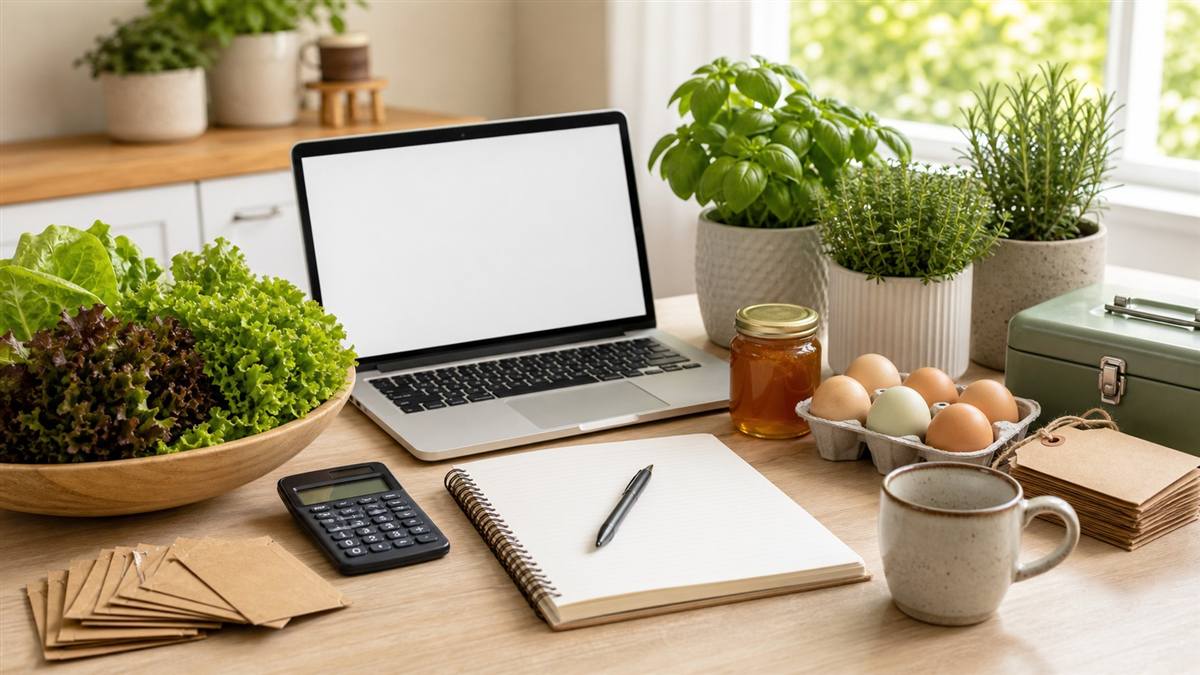
A homestead business plan sounds formal. It doesn’t have to be. What it needs to do is answer four questions: What will you sell? Who will buy it? What does it cost to produce? And what will you realistically earn?
This guide walks you through building a practical homestead business plan — not a 40-page document for a bank loan, but the kind of working plan that helps you make smart decisions about what to grow, what to sell, and how to build toward actual profit rather than busy activity that doesn’t move the needle.
Table of Contents
- Step 1: Define Your Product
- Step 2: Know Your Market
- Step 3: Map Your Cost Structure
- Step 4: Set Your Pricing
- Step 5: Build Your Income Projections
- Step 6: Calculate Startup Capital Needed
- Step 7: Plan Your Operations
- Step 8: Legal and Regulatory Considerations
- Sample One-Page Homestead Business Plan
- Frequently Asked Questions
Step 1: Define Your Product
The most important decision in a homestead business plan is what you’re selling. Not what you enjoy growing — what customers will pay for reliably. These overlap more than you might think, but the starting point is the customer, not your preferences.
The homestead products with the most consistent demand at small scale:
- Living lettuce and herb plants (indoor hydroponic, year-round)
- Fresh cut herbs (year-round indoors, seasonal outdoors)
- Pasture-raised eggs
- Specialty garlic and heirloom vegetable starts
- Value-added preserved foods (jams, pickles, dried herbs)
- Cut flowers
Choose one primary product to start. It should be something you can produce reliably, that has clear local demand, and that you can sell at a price that makes economic sense. For most beginners, living plants or fresh herbs from an indoor hydroponic system is the lowest-friction starting point — fast to set up, fast to first sale, and year-round.
The homestead income ideas guide covers each product category with honest economics, which is worth reading before finalizing your product choice.
Step 2: Know Your Market
Your market is the people who will actually buy from you. For a small homestead, that’s almost always local — neighbors, farmers market customers, local restaurants. National or regional e-commerce is possible for shelf-stable products but adds complexity that’s worth avoiding at the start.
Market Research Questions
- Who is your ideal customer? Health-conscious families? Busy professionals who cook? Restaurant chefs? The answer shapes everything from what you grow to how you communicate about it.
- How many potential customers are within reach? A neighborhood of 200 households where you can reach 10–15 regular customers is a viable market. A rural road with 12 houses may not be.
- What are they currently buying? Check local farmers market vendor variety, specialty grocery store pricing, and neighborhood social media to understand what’s available and what people are looking for.
- Is there a gap you can fill? A local market well-supplied with cut produce but no living plants. A neighborhood with no local herb source. A restaurant cluster with no reliable fresh herb supplier. Gaps create easier market entry.
Simple Market Test Before Committing
Before investing in production infrastructure, test demand. Post on Nextdoor: “I’m considering growing locally and selling direct — would anyone be interested?” Responses tell you more than any formal market research. If 10 neighbors express interest, you have a market. If none do, you need to reconsider your product or channel.
Step 3: Map Your Cost Structure
Costs break into two categories: fixed costs (one-time setup expenses) and variable costs (ongoing per-unit production costs).
Fixed Costs (Example: Indoor Lettuce Tote Operation)
| Item | Cost | Lifespan |
|---|---|---|
| Wire shelving unit | $80 | 10+ years |
| LED grow lights (4) | $120 | 5+ years |
| Outlet timers (4) | $50 | 3+ years |
| Storage totes (10) | $60 | 3–5 years |
| Net pots, clay pebbles, pH kit | $40 | 1–2 years |
| Total fixed costs | $350 |
Variable Costs (Per Tote)
| Item | Cost Per Tote |
|---|---|
| Seeds | $0.30 |
| Nutrients | $0.50 |
| Electricity | $1.50 |
| Growing medium (amortized) | $0.50 |
| Total variable cost per tote | ~$2.80 |
Understanding your cost structure tells you your break-even point and minimum viable price. In this example, you need to sell each tote for more than $2.80 to profit — which at a $35 selling price gives you a margin of $32.20 per unit. That’s an exceptional margin; most homestead products won’t look quite this good, but most should still pencil out clearly.
Step 4: Set Your Pricing
Price based on value to the customer and comparable market prices — not on your cost of production. Your cost structure tells you the minimum; market research tells you the ceiling; your pricing should be somewhere in between, on the higher end.
Rules for homestead pricing:
- Never price below your full cost of production including your time
- Match or exceed specialty/local grocery pricing, not commodity pricing
- Price living plants at 2–3x the retail price of the equivalent harvested product — the ongoing value justifies the premium
- Offer a subscription discount (10–15%) to incentivize recurring orders without dramatically reducing margin
- Start higher than you think — it’s easy to discount, hard to raise prices
Step 5: Build Your Income Projections
Realistic income projections require three numbers: your average sale price, your weekly unit volume, and your operating weeks per year. For a year-round indoor operation, that’s 52 weeks. For a seasonal outdoor operation, it might be 20–28 weeks.
| Scenario | Units/Week | Price | Weekly Revenue | Annual Revenue | Annual Costs | Annual Profit |
|---|---|---|---|---|---|---|
| Conservative start | 2 totes | $35 | $70 | $3,640 | $500 | $3,140 |
| Established (6 months) | 5 totes | $38 | $190 | $9,880 | $900 | $8,980 |
| Scaled (12+ months) | 10 totes | $40 | $400 | $20,800 | $1,500 | $19,300 |
These projections assume year-round indoor production. Outdoor-only operations should calculate based on their actual growing season length. The indoor growing advantage — no seasonal downtime — is significant in annual income calculations.
Step 6: Calculate Startup Capital Needed
Add your fixed costs plus 2–3 months of variable costs and operating expenses before you expect revenue. This is your startup capital requirement. For most small homestead operations, this is $300–$1,000 — within range for most people without external financing.
If your startup capital requirement exceeds what you have available, start smaller. A $150 single-shelf setup generating $70/week is a real business that funds its own expansion. You don’t need to be fully scaled from day one.
Step 7: Plan Your Operations
An operations plan answers: what does a typical week look like? When do you plant? When do you sell? How do you handle delivery? What happens if you go on vacation?
For a small indoor growing operation, the weekly operations plan is simple:
- Monday: Check pH on all totes, assess which are ready to sell this week
- Tuesday/Wednesday: Customer communication, schedule pickups or deliveries
- Thursday: Plant replacement totes for any sold this week
- Weekend: Deliver or arrange pickup for ready totes
Total time: 45–90 minutes per week. That’s sustainable alongside any other commitments — which is why this model works for most people.
Step 8: Legal and Regulatory Considerations
We’re not lawyers, and this is not legal or tax advice. What follows is a general orientation to the questions worth asking — not answers you should rely on without verifying for your specific state, county, and situation. Before your first sale, we’d encourage you to spend an hour with your state’s Department of Agriculture website and, if you’re planning to invest meaningfully in your operation, a local attorney or small business advisor.
The questions to research for your situation:
- Licensing: Does your state require any registration or license for direct produce sales at your scale? Requirements vary significantly by state and by what you’re selling.
- Business structure: Selling as a sole proprietor is the simplest starting point for most people. An LLC can provide liability protection as your business grows — a local attorney can advise on whether that makes sense for your situation and how to set it up correctly in your state.
- Taxes: Homestead income is generally taxable. A tax professional can advise on how to report it correctly, which expenses are deductible, and what records to keep. Don’t assume — get actual advice for your situation.
- Zoning: Check your local zoning ordinances and any HOA or deed restrictions that apply to your property before starting any commercial activity.
- Food safety: If you’re selling processed products (jams, dried herbs, anything beyond fresh produce and living plants), cottage food laws apply and vary considerably by state.
The guide to selling produce from home covers the general legal landscape and — more usefully — where to find the authoritative answers for your location.
Sample One-Page Homestead Business Plan
Here’s what a simple, practical homestead business plan looks like when you put it all together. This is a template — the legal and regulatory line in particular needs to be filled in based on your actual research for your location, not assumed.
Indoor Mini Farm — Home Business Plan (Template)
Product: Living hydroponic lettuce totes (6 plants, ready-to-harvest), fresh herb plants (basil, cilantro, mint)
Target customer: Health-conscious households within 5 miles; families who buy fresh salad greens and herbs weekly
Sales channel: Direct-to-neighbor via Nextdoor and word of mouth; monthly subscription for regular customers; farmers market once established
Pricing: Lettuce totes $35–$45; herb plants $8–$15; subscription customers receive 10% discount
Startup costs: $350 (shelving, lights, timers, totes, growing supplies)
Variable cost per tote: ~$3
Year 1 goal: 5 regular customers, 3–4 totes/week, $500–$700/month revenue
Year 2 goal: 10 regular customers + farmers market, 8–10 totes/week, $1,200–$1,600/month revenue
Weekly time commitment: 1–2 hours
Legal: [Fill in after researching your state’s direct produce sales rules, local zoning, and any HOA restrictions. Consult a local attorney if you’re planning to invest significantly. Don’t assume — verify.]
Tax approach: [Discuss with a tax professional. Track all income and expenses from day one.]
That’s a working business plan. It’s not a formal document — it’s a decision-making tool. Review it monthly in the first year and update as you learn what’s actually working.
For the complete production system this plan is built around, the Indoor Mini Farm System covers everything from setup through to a stable, recurring customer base.
Frequently Asked Questions
Do I need a business plan to start a homestead business?
Not a formal one. But answering the core questions — what you’ll sell, who will buy it, what it costs, and what you’ll charge — before you invest in equipment saves significant time and money. Even a one-page plan clarifies your thinking and helps you make better decisions as you go.
How do I start a small homestead business with no money?
Start with the lowest-cost viable product. A single Kratky jar for herbs costs $10–15 to set up and can generate your first sales within 30 days — which then funds the next tote. A spring seedling sale requires only seed trays and seeds, which cost under $20, and can generate hundreds of dollars in a single weekend. Scale from whatever you can fund yourself before investing in more infrastructure.
Is a homestead a business for tax purposes?
If you’re generating income from homestead activities, you likely have taxable income — but how to report it, what’s deductible, and what records to keep are questions for a tax professional who knows your situation. Keep a simple income and expense record from the start regardless, so you have the information available when you need it.
A homestead business plan doesn’t need to be complicated — it needs to be honest. Know your costs, know your market, price accordingly, and start small enough to learn without significant financial risk. If you’re ready to build the production system the plan runs on, the Indoor Mini Farm System is the complete guide.