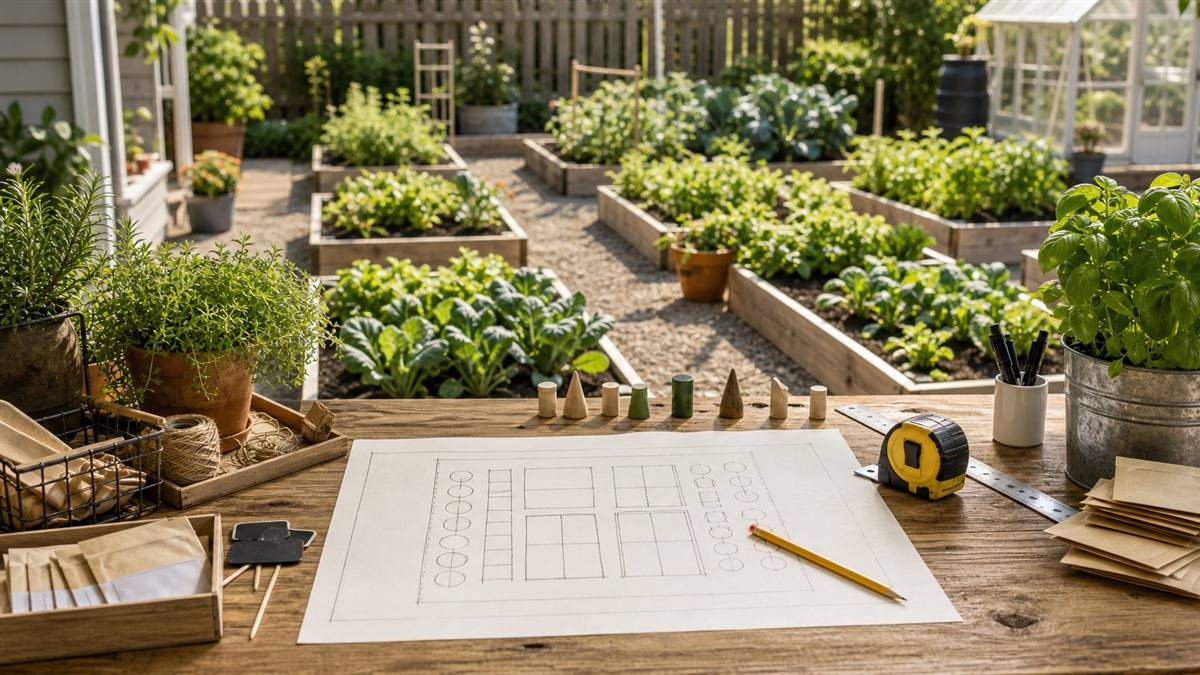
How you arrange your growing space matters almost as much as what you grow in it. A poorly planned layout means wasted sun, awkward access, poor soil management, and plants competing when they should be complementing each other. A well-designed one makes the same square footage significantly more productive — and significantly more enjoyable to work in.
This guide covers the best homestead garden layout ideas for small lots — from simple raised bed arrangements to integrated systems that combine outdoor beds, vertical growing, and indoor production into a coherent whole.
Table of Contents
- Layout Principles That Apply to Every Garden
- Raised Bed Layout Ideas
- Homestead Zoning: Organizing Your Space by Use
- Integrating Vertical Growing
- Where to Put Perennials
- Connecting Indoor and Outdoor Growing
- Layout Ideas for Very Small Lots
- Companion Planting Within the Layout
- Frequently Asked Questions
Layout Principles That Apply to Every Garden
Before getting into specific configurations, a few principles apply regardless of your lot size or growing goals.
Sun First, Everything Else Second
Place your most productive vegetable beds in the location with the most direct sunlight — full sun (6–8+ hours) for fruiting crops, partial sun (4–6 hours) for leafy greens and cool-season crops. This sounds obvious but is frequently violated when people place beds where they look nice rather than where they’ll actually produce. No amount of good soil or careful planting compensates for inadequate light.
Orient Beds North-South
Running your beds north-south (the long side facing east-west) ensures that all plants receive roughly equal light throughout the day. East-west oriented beds tend to have the north side shaded by the south side plants as they grow taller. If you have tall trellises, position them at the north end of the bed so they shade only empty space (or deliberately planted shade-tolerant crops).
Prioritize Access
Every part of a garden bed should be reachable from a path without stepping in the bed. The standard raised bed width of 4 feet is based on this — most people can reach 2 feet comfortably from either side. Wider beds look efficient on paper but create compaction problems when you inevitably have to step in them.
Keep paths at least 18–24 inches wide for comfortable access with a wheelbarrow. Permanent pathways that are mulched or paved save enormous ongoing labor by suppressing weeds without maintenance.
Group by Water Needs
Thirsty crops (tomatoes, cucumbers, squash) are easiest to manage when they’re in the same zone, ideally with drip irrigation on one line. Cool-season crops (lettuce, spinach, kale) need less water and can be in a different zone or on a separate irrigation line. Herbs, once established, prefer drier conditions than most vegetables.
Raised Bed Layout Ideas
The Simple Parallel Layout (Best Starting Point)
Two to four 4×8 ft beds arranged in parallel rows with 24-inch paths between them. This is the standard layout for good reason — it’s simple to build, easy to manage, and highly productive. Total footprint for four beds: approximately 20×12 ft.
Place a trellis structure at the north end of each bed for vertical crops (cucumbers, beans, tomatoes). Plant tall crops at the north end of each bed, medium crops in the middle, and low crops at the south end to minimize shading.
The U-Shape Layout
Three beds arranged in a U configuration with a central workspace. This layout gives you access to all beds from the center without walking around the perimeter. Excellent for small or square spaces where a linear arrangement would be awkward. Good for accommodating a central water source, compost bin, or tool storage in the middle of the working space.
The Keyhole Layout
A circular or curved bed with a narrow path cut into the center like a keyhole. You access the whole bed from the center path without walking around the perimeter. Space-efficient and ergonomic — reduces the total path area required compared to rectangular beds. Particularly useful on uneven terrain where straight beds don’t work well.
The Intensive Square Foot Layout
Beds are divided into 1-foot squares, each planted with a specific number of plants based on their mature size (one tomato per square, four lettuce plants per square, 16 carrots per square, etc.). Maximizes production per square foot by eliminating wasted space between plants. Requires more planning upfront but dramatically increases yield per bed compared to traditional row planting.
Homestead Zoning: Organizing Your Space by Use
Beyond individual bed placement, thinking about your space in zones helps organize activities logically and reduces the friction of daily homestead tasks.
Zone 1: High-Frequency Zone (Closest to House)
The beds, containers, and systems you visit every day — your primary vegetable garden, your herb pots, your indoor growing shelf. Everything you harvest from daily should be as close to your kitchen as possible. A 10-second trip to pick fresh herbs is something you’ll actually do; a 10-minute walk to a back garden bed often isn’t.
This is also where your indoor growing system fits — immediately accessible, integrated into your daily routine, not a separate expedition.
Zone 2: Regular-Tending Zone (Mid-Distance)
Crops you check every 2–3 days: tomatoes, cucumbers, beans, squash. Your main vegetable beds. Compost bins. Irrigation controls. These get visited multiple times per week during peak season but don’t require daily access.
Zone 3: Low-Frequency Zone (Furthest from House)
Crops and systems that need weekly or less frequent attention: fruit trees, berry bushes, garlic and onion beds, cover crops, any small livestock. These don’t need to be close to the house and benefit from being in areas that may not be ideal for intensive vegetable production.
Integrating Vertical Growing
Every homestead layout should include vertical growing infrastructure — it’s the single most effective way to increase production per square foot without expanding your footprint. The key is designing vertical structures into the layout from the beginning rather than adding them as an afterthought.
- Fence lines — The perimeter fence of any yard is free vertical structure. A row of cucumbers, beans, or even small squash trained up an existing fence adds significant production with zero additional footprint.
- Trellis at bed ends — A permanent T-post and wire trellis at the north end of each raised bed handles all your vertical crops without requiring a separate structure.
- Arbors and pergolas — Train grapes, hops, hardy kiwi, or annual climbers (scarlet runner beans, cucumbers) over a patio arbor. Provides shade in summer and food overhead.
- Wall-mounted pocket planters — On any south-facing wall or fence, vertical pocket planters add herb and strawberry growing space from surfaces that otherwise contribute nothing to production.
For a full breakdown of vertical growing strategies and structures, the vertical gardening guide covers everything from simple trellis builds to tower garden systems.
Where to Put Perennials
Perennial crops — fruit trees, berry bushes, asparagus, artichokes, perennial herbs — need permanent spots in your layout because disturbing established perennials is counterproductive. Plan their placement carefully before committing.
Perennial Placement Rules
- Plant on the north side of annual beds so they don’t shade them. A row of blueberry bushes or a dwarf apple tree on the north border of your garden creates a productive windbreak without shading your vegetable beds.
- Create a dedicated perennial bed that won’t be disturbed by annual crop rotation. A 4×8 or 4×12 ft permanent bed for asparagus, strawberries, and perennial herbs gives you a stable, productive zone that improves every year.
- Account for mature size. A dwarf apple tree looks manageable at planting but shades a significant area at maturity. A semi-dwarf apple tree 15 years later is a substantial structure. Plan for what things will become, not what they are when you plant them.
- Group fruit trees to aid pollination. Most apple, pear, and cherry varieties need cross-pollination from another variety. Plant compatible varieties within 50 feet of each other.
Connecting Indoor and Outdoor Growing
The most productive homestead layouts treat indoor and outdoor growing as one integrated system rather than two separate activities. This means thinking about how your indoor shelf and your outdoor beds work together to produce food through every season.
In practice, this looks like:
- Using your indoor grow light setup to start transplants in late winter for the outdoor spring garden — tomatoes, peppers, cucumbers — instead of buying starts
- Running your indoor hydroponic greens system year-round so there’s never a gap in fresh leafy produce regardless of outdoor season
- Moving production between indoor and outdoor as seasons shift — more outdoors in summer, more indoors in winter
- Using your outdoor garden’s compost to improve the growing environment for soil-based indoor starts
For a complete picture of how this seasonal integration works through the year, the year-round vegetable garden plan maps out what’s growing where in each season. And for the best crops to grow on the indoor side of that system, the self-sufficiency crop guide ranks them by practical value.
Layout Ideas for Very Small Lots
If you have less than 500 square feet of outdoor growing space, strategic layout becomes even more important. Here’s how to maximize a very small footprint:
The One-Bed Intensive Layout
One 4×8 ft raised bed planted using square foot method, with a trellis at the north end for vertical crops. That single bed, intensively managed, can produce a meaningful amount of food: 4–6 tomatoes (or cucumbers) vertically, plus 12–16 lettuce plants, herbs along the edges, and beans running up the trellis. It’s not a complete food garden, but it’s a highly productive use of minimal space.
The Container and Wall Layout
No raised beds at all — grow everything in containers on a patio or balcony, using every vertical surface available. Two large containers (15 gallon) for cherry tomatoes, three 5-gallon containers for cucumbers or peppers, wall-mounted pocket planters for herbs, and railing planters for lettuce. Combined with an indoor hydroponic system for year-round greens, this fully patio-based approach produces a surprising amount of food from zero ground space.
For the full container approach, the container gardening guide covers what works and what doesn’t in detail.
Companion Planting Within the Layout
Companion planting — growing mutually beneficial plants together — adds another layer of efficiency to any layout. The best-documented companion combinations for a homestead garden:
| Plant | Good Companions | Why It Works |
|---|---|---|
| Tomatoes | Basil, marigolds, carrots | Basil may repel aphids; marigolds deter nematodes and whiteflies |
| Beans | Corn, squash, carrots | Beans fix nitrogen; corn provides structure; squash suppresses weeds |
| Cucumbers | Dill, beans, sunflowers | Dill attracts beneficial insects; sunflowers provide trellis support |
| Lettuce | Carrots, radishes, tall crops | Grows in shade of taller plants; radishes deter lettuce aphids |
| Kale/brassicas | Dill, celery, onions | Dill and onions repel cabbage worms and aphids |
| Garlic | Almost everything | Broad pest-deterrent effect; especially good near roses and fruit trees |
The Three Sisters combination — corn, beans, and squash — is the most famous companion planting system, developed by Native American farmers over centuries. The corn provides a trellis for the beans; the beans fix nitrogen; the squash’s large leaves shade the ground, suppressing weeds and retaining moisture. Plant them together in a 4×4 ft block for a self-supporting, productive combination that improves soil as it grows.
If growing your own food is the goal, the most important companion to your outdoor layout is an indoor growing system that keeps producing through winter. The Indoor Mini Farm System is the complete guide to building that indoor complement — the part of the system that makes year-round food production genuinely possible regardless of your outdoor layout or climate.
Frequently Asked Questions
How should I layout a small vegetable garden?
Start with one or two 4×8 ft raised beds oriented north-south in the sunniest part of your space, with a trellis at the north end for vertical crops. Add a permanent perennial border on the north side if you have room. Keep paths 18–24 inches wide for comfortable access. Place the most-used crops (herbs, salad greens) closest to the house. Add beds or containers as your confidence and space allow.
What is the most productive small garden layout?
The combination of intensive raised bed growing (square foot method) with vertical structures for climbing crops consistently produces the most food per square foot. Adding an indoor growing system for year-round greens significantly increases total annual output from the same footprint. For a very small lot, the container-and-wall approach — maximizing every vertical surface — can rival traditional bed growing in total yield.
How do I design a homestead garden?
Observe your space for a full season before making permanent changes. Map sun, shade, water access, and wind. Organize by zones based on visit frequency — daily-use crops near the house, weekly-tended crops further out. Place annual beds in full sun, perennials where they won’t shade annuals. Integrate vertical growing throughout. Plan for indoor growing as a year-round complement to outdoor production.
Should raised beds run north-south or east-west?
North-south orientation — the long sides of the bed facing east and west — gives all plants roughly equal sun exposure throughout the day and is generally preferred for most vegetables. East-west beds tend to have the northern plants shaded by southern ones as they grow. The exception: if you have a slope, orient beds across the slope (on contour) to prevent erosion and runoff, regardless of compass direction.
A good layout makes every hour in the garden more productive and every harvest more satisfying. Design it thoughtfully once and it pays off for years. If you’re ready to add the indoor piece that makes the whole system work year-round, the Indoor Mini Farm System is the complete guide to getting it running alongside your outdoor garden.