Gwen stared at the grocery receipt like it was a warning label.
The total felt wrong. Higher again. Always higher.
She had done everything “right.” Generic brands. Fewer treats. More “healthy stuff” for the kids because every other article she saw was about ultra processed food and what it does to growing brains.
But the number at the bottom of the receipt didn’t care how hard she tried.
Once home, she did what most of us do when we are stressed and tired. She scrolled.
Another headline about layoffs in her industry.
Another story about contaminated food.
Another think piece about those new weight loss drugs, and how they might not be as safe as she had hoped.
By the time she fell asleep, Gwen had convinced herself of two things:
- Things are getting shakier than anyone wants to admit.
- Her kids still need real food, every single day, no matter what the government or grocery chains do.
She wanted a backup.
Not a bunker. Not a TikTok side hustle where she was shipping plastic trinkets around the world.
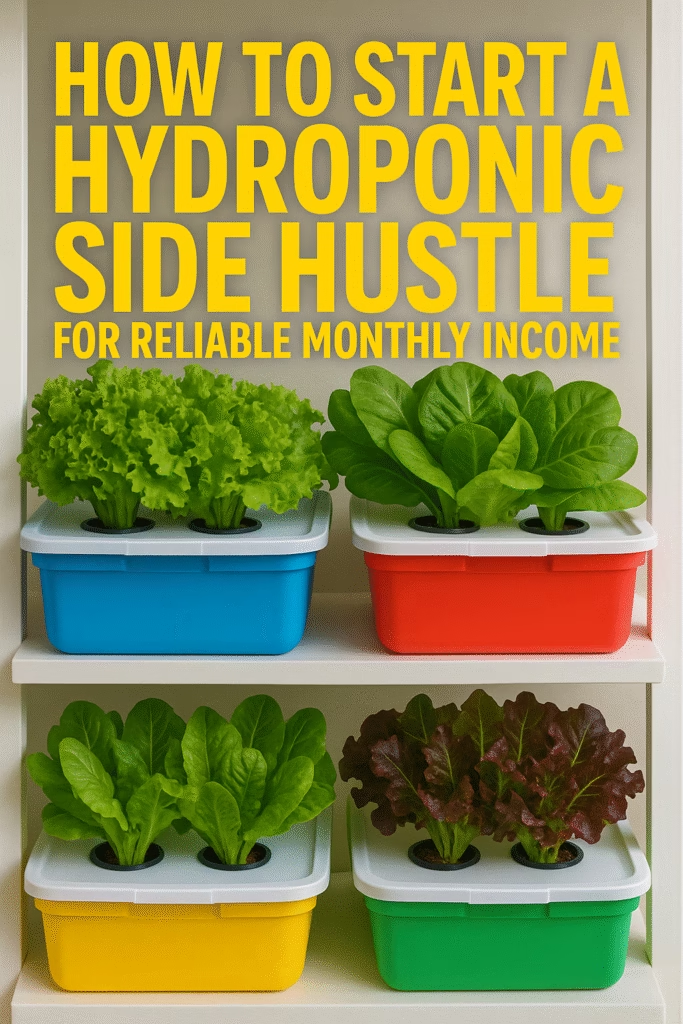
Something small, sane, and real.
Something that quietly fed her kids and gave her a little extra money, without turning her life upside down.
The problem was time.
She didn’t have hours to weed a garden or learn a whole new trade. She had two kids, a job that felt like it was on thin ice, and evenings that disappeared into homework, dishes, and “Mom, where are my shoes.”
So she did what most people do.
She worried. Then she tried to forget about it.
Until she saw a photo that stopped her thumb.
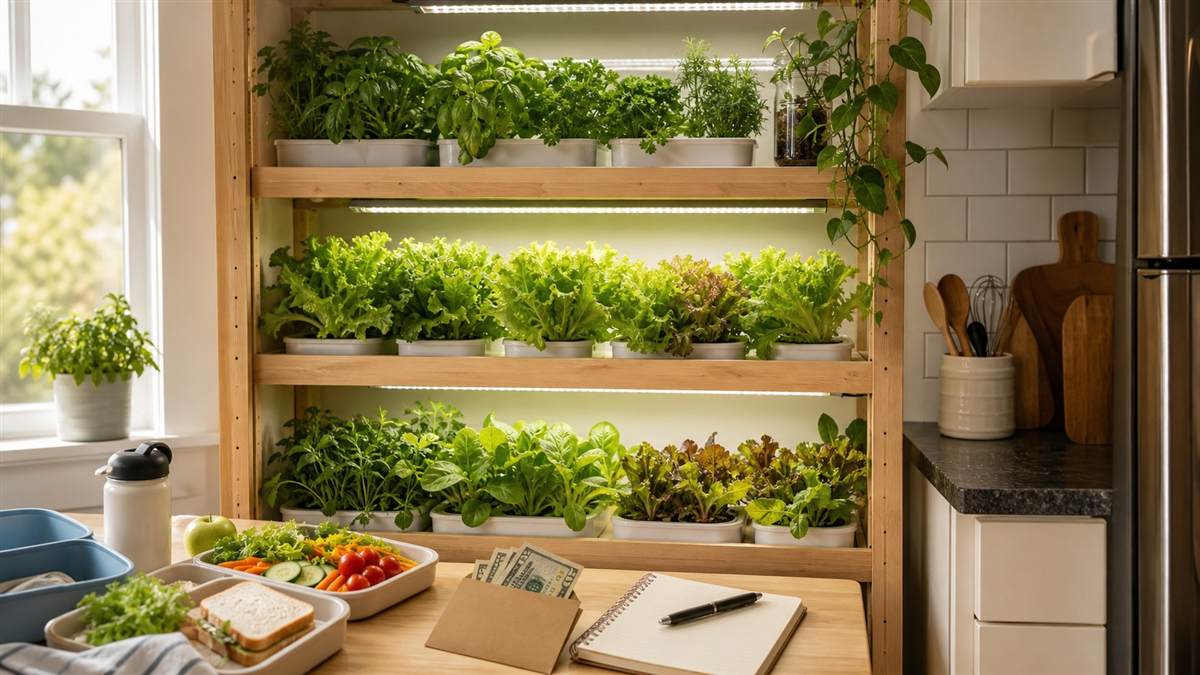
A bookshelf.
Not filled with books.
Filled with food.
The “Bookshelf Farm” That Shouldn’t Work… But Does
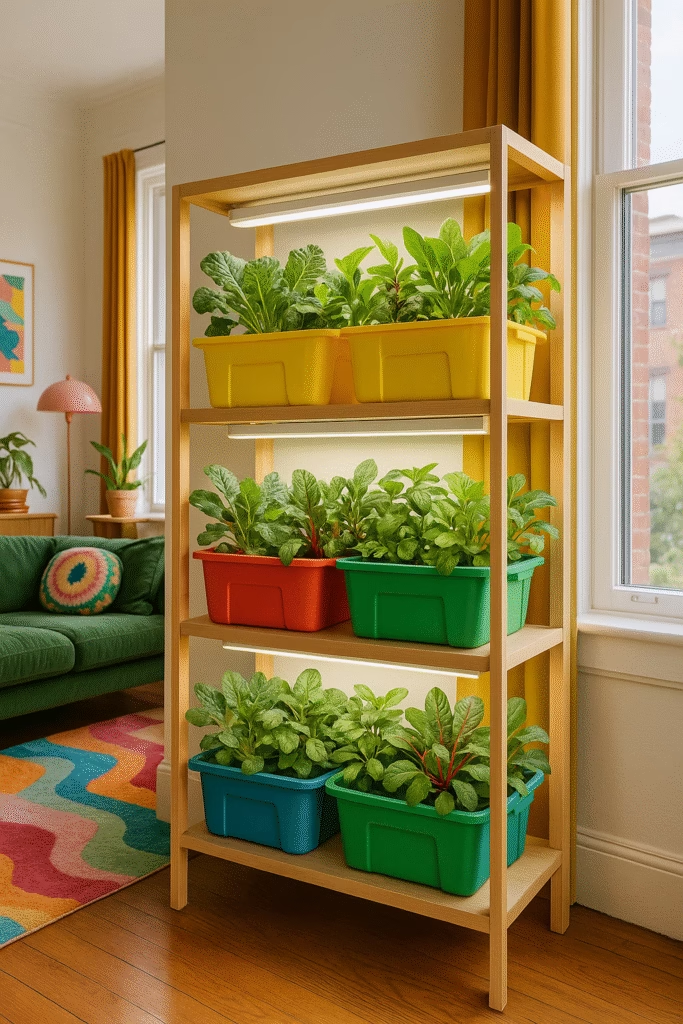
The photo looked almost fake.
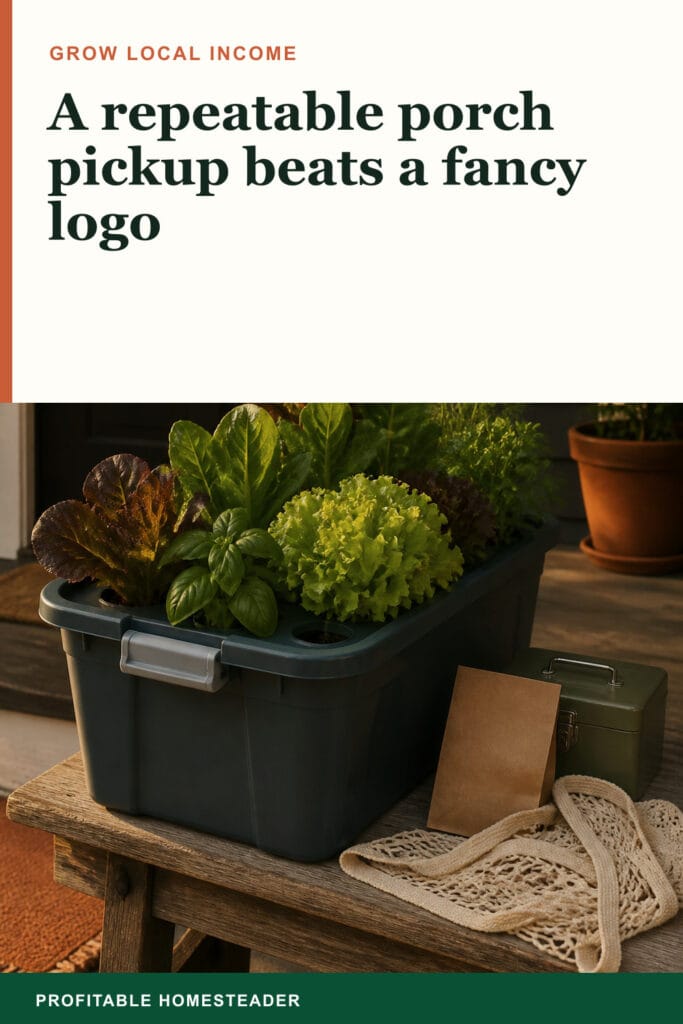
Instead of dusty paperbacks, there were rows of shallow storage totes on a sturdy shelf. Each lid had neat little holes, and out of those holes were explosions of green.
Kale. Chard. A few herbs she could not name.
Under each shelf, simple grow lights. Nothing fancy. No complicated control panels or spaghetti of wires.
“Indoor Mini Farm,” the caption said.
Underneath, someone had commented:
“This thing basically waters itself. I only touch it once a week.”
That was the sentence that hooked Gwen.
Want the exact setup Gwen used?
- 5 sq ft bookshelf system
- No pump, no daily watering
- Beginner-friendly, weekend build
- Step-by-step PDF + supply list
$47 • Instant download • 30-day guarantee
Because if you have ever tried to grow things while raising kids, you already know the truth:
You don’t forget to feed your kids.
You do forget to water your plants.
Every time.
What she was looking at was not a pretty Pinterest project. It was a system.
A way to grow real food in five square feet of space, with no daily watering, no soil, no weeding, and no praying that the weather cooperates.
Not a backyard dream. A bookshelf reality.
How A Mini Farm Actually Works (In Plain English)
Let me pull back the curtain for a second.
My name is Tyler Brown. I grew up in North Carolina, married my high school sweetheart, and yes, we have land.
But most of the food that really matters to my family right now isn’t coming from a big picturesque garden.
It comes from a few plastic totes on a shelf.
Here’s the simple version of what Gwen saw.
- You take opaque, shallow storage totes.
- You drill holes in the lids for small plant cups.
- You fill the tote with water and nutrients.
- You put the planted cups in the holes.
- You set the tote on a shelf with a basic grow light above it.
That’s it.
There’s no pump buzzing in the background. No hoses. No timers.
The roots sit in the water and drink what they need. As they grow, they pull the water level down and grow air roots. Every few weeks, you rinse the roots and refill the tote.
You can ignore the whole thing for days at a time and nothing dies.
The plants don’t care that you had a rough week at work. They don’t care that your kid had the stomach flu and you forgot what day it was.
They just grow.
For Gwen, that meant one mini farm could give her enough greens for smoothies for about a week.
Ten mini farms could feed her kids more real food than she ever thought possible from a rental kitchen, and give her something else that mattered just as much.
Options.
“I Don’t Want To Sell Junk”
Here’s where a lot of parents get stuck.
It’s not just about food. It’s about money.
Gwen knew she should have some kind of backup income. Everyone should. But every time she thought about it, she felt gross.
The world doesn’t need more cheap plastic thingamajigs.
She didn’t want to pester her friends with yet another “hey girl, I have an opportunity for you” DM.
She wanted a way to bring in extra money that actually helped people.
When you grow food on a bookshelf, something interesting happens.
You realize that:
- Baby plants are worth more than seeds.
- Ready to harvest greens are worth more than baby plants.
- Most people want the food, not a learning curve.
So instead of trying to “get rich online,” Gwen could do something simple and honest.
She could sell:
- Weekly smoothie greens bundles.
- Salad mixes for busy neighbors.
- Subscription plant boxes for other parents who wanted to dip a toe into growing.
No funnels. No webinars. No pretending to be a guru.
Just good food, for people who live down the street.
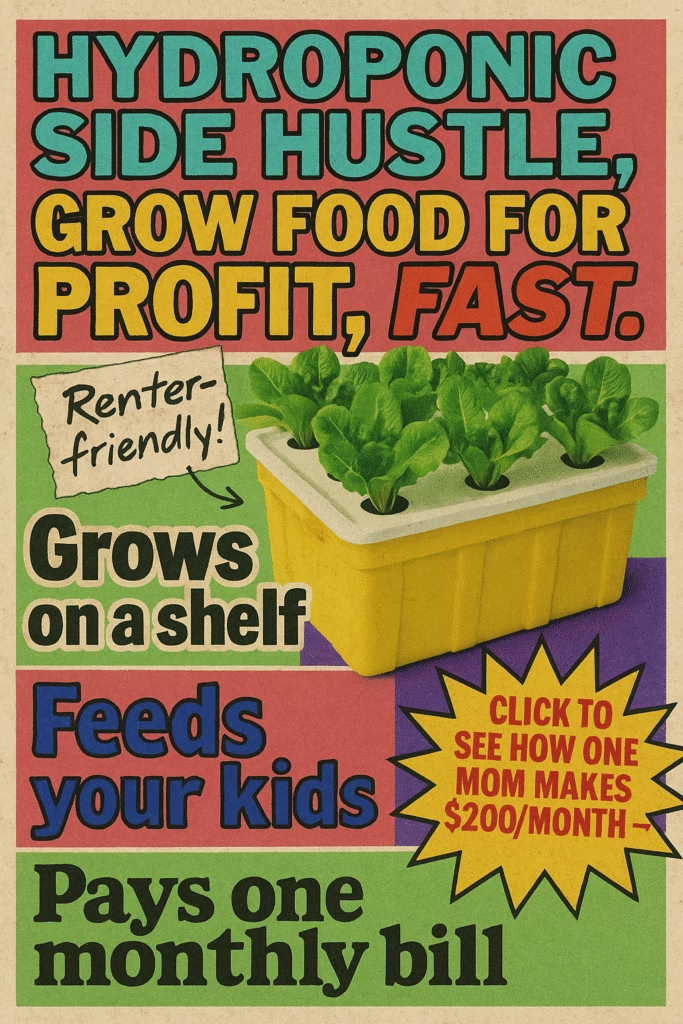
Lisa from Burlington did exactly that:
“Earned $200 in my first 30 days…
The confidence I got from building a mini farm is priceless. My kids love seeing the plants grow, and the extra income is changing our budget.”
Ten mini farms, sold out each month, is roughly $300 in profit.
Not lottery money. But the kind of money that makes the grocery bill hurt less. The kind of money that turns “I hope my job lasts” into “I have at least one thing I control.”
And if you never sold a single leaf, you would still have something most people do not.
Food that starts in your own living room.
“But I Kill Every Plant I Touch”
This is the other voice in the back of Gwen’s head.
Maybe yours too.
You’ve tried to grow a vegetable garden before. Everything fizzled. Dramatically.
So why would this be any different?
Because the system was built for people who forget to water things.
Daniel from Asheville put it better than I ever could:
“I have a black thumb, but really wanted to grow fresh food at home. I was skeptical, but the Mini Farm System made it foolproof. Thanks to the bonus planner, I haven’t missed a harvest cycle yet. And the marketing plan is genius. I never would have thought of selling plants as a subscription, but my neighbors are thrilled.”
When I put the Indoor Mini Farm System together, I did it with people like Gwen and Daniel in mind.
Parents who are not trying to become full time farmers. They just want something that:
- Fits in a corner of their kitchen or living room.
- Takes under 30 minutes a week to maintain.
- Does not die when life gets busy.
So the system walks you through:
- Exactly which totes, lights, and supplies to buy, with direct links.
- How to set them up in a few hours, even if you have never used a drill.
- What to plant first so you see fast results and don’t get discouraged.
- How to use a simple perpetual planner so you always know “this week, I do this.”
You’re never staring at a tray of half dead plants wondering what went wrong.
You are simply following a checklist that has already been tested in real homes.
Quiet Preparedness, Without The Bunker
There’s something else Gwen liked, even though she might not say it out loud.
She wanted to be ready if things get worse.
But she didn’t want to be the “crazy prepper friend” who’s always talking about it.
The indoor mini farm is the perfect middle path.
To the outside world, it looks like an interesting hobby. A cool talking point when someone visits.
In reality, it’s:
- A steady stream of real, nutrient dense food.
- A way to stretch every grocery dollar further.
- A soft landing if prices spike or shelves run low.
- A small, ethical side income if she decides to sell.
No bunker. No fifteen year supply of powdered soup.
Just living plants, under lights, that keep doing their thing while you are at work or helping with homework.
This is the belief I will happily put a line in the sand around:
You don’t need land to feed your family.
You can grow and sell high value plants that actually help people, on a tiny footprint, in a way that feels admirable.
You can be the calm parent who quietly took responsibility, without trying to drag anyone else into your anxiety.
What Gwen Used To Get Started
Here’s the part where most plans pieces turn into a circus.
So let’s keep it simple.
If you’re reading this and thinking, “I want that, but I have no idea where to start,” that’s exactly why I created:
The Indoor Mini Farm System
It’s a step by step PDF guide that shows you how to build and run your own bookshelf farm in a weekend.
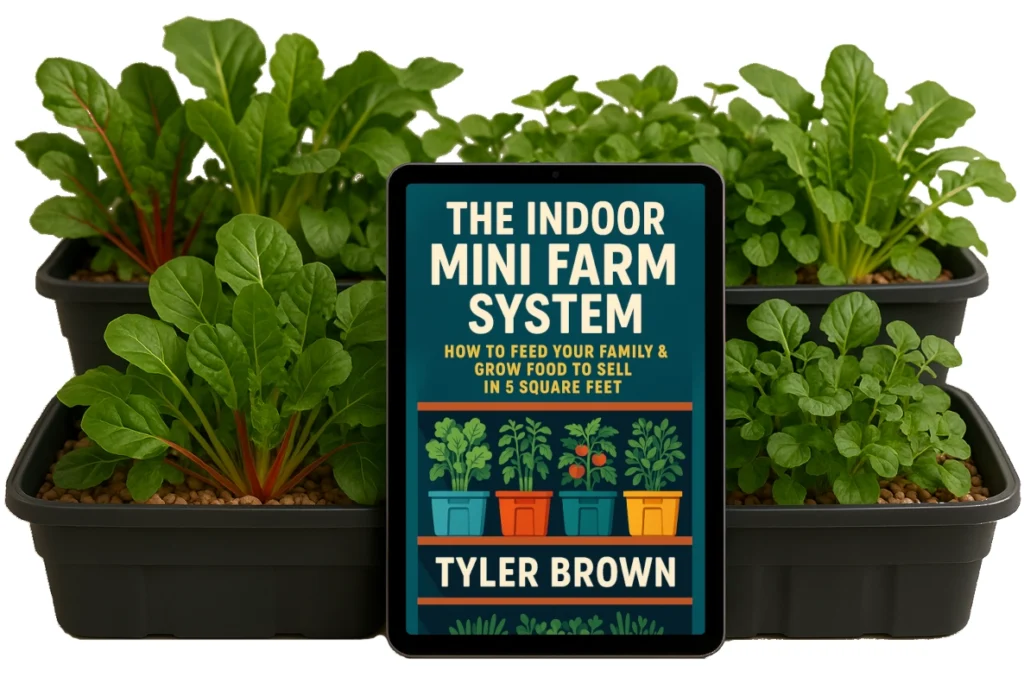
Here’s What You Get
Indoor Mini Farm System (PDF)
Every step you need to create your indoor mini farm in just a few hours. From which totes to buy to how high to hang your lights to which seeds to plant first.
Linked Supply List (PDF)
Instead of opening twenty tabs and guessing, you get a simple list with direct links to exactly what you need. You can be done shopping in minutes.
Perpetual Planner (PDF)
This is the piece that keeps black thumbs alive. A simple perpetual planner that tells you, week by week, what to do so you never miss a refill or harvest.
Just $47 for everything
If the only thing this did was give your kids smoothies made from greens you grew yourself for a few months, it would be worth that.
If it helps you earn even 100 dollars in extra income, it pays for itself more than once.
A lot of people do more than that.
Real Readers. Real Mini Farms.
These are everyday readers who started with one tote on a bookshelf and turned it into fresher food and extra cash.
“I was skeptical, but my first harvest more than covered the cost. Now my kids snack on greens instead of chips.”
I started with one tote next to our kitchen table. Once I saw how fast everything grew, I added two more and now I’m selling salad plants to three of my neighbors.
Sara C., Columbus, OH
“This gave me a simple plan I could follow after the kids went to bed.”
I don’t have space for a ‘real’ garden, but the mini farm system fits on a cheap bookshelf in our hallway. We eat off it every week, and I sell six totes a month to cover our internet bill.
Jen S., Houston, TX
“I’ve tried so many ‘systems’ that overpromised and fizzled out. This one quietly does what it says.”
I work full time and needed something low-maintenance. I spend maybe 10 minutes twice a week checking water levels and harvesting. The rest just… grows.
Sam L., Raleigh, NC
“We live in an apartment and I honestly didn’t think this would work.”
We’re on the third floor with no balcony. The totes fits next to our dining table and now my 7-year-old helps me harvest ‘our’ salad every night. It feels like cheating the grocery store.
Pam D., Boise, ID
And if you decide you want help selling out every harvest, there’s also a short companion guide called Sold Out Every Time you can pick up later.
In that guide, I walk you through exactly how to:
- Price your plants and greens so they move fast and still feel fair.
- Offer simple subscriptions your neighbors are excited to renew.
- Sell without feeling like a pushy salesperson.
As a thank you, I’ll send you an infographic about my three favorite plants to grow hydroponically.
Everything is covered by a 30 day guarantee.
If you get the guide and think, “Nope, this is not for me,” just email me and let me know. I’ll refund you out of my own pocket. No quiz. No guilt.
If You Feel That Little Nudge
If you’ve read this far, something in you already knows what I am about to say.
You don’t control the government.
You don’t control your company’s decisions.
You can’t make grocery chains suddenly care more.
You can control what is growing five feet from your kitchen table.
You can control whether your kids see food as “something that shows up in a bag” or “something that grows because we took care of it.”
You can give yourself a small, quiet income stream that doesn’t depend on someone else’s algorithm or agenda.
That starts with one simple decision:
Set up your first mini farm.
Whether you end up with ten mini farms and a waiting list of neighbors, or just a steady supply of greens for your own blender, you’ll be glad you started now instead of waiting for the next scary headline.
Click through, grab the Indoor Mini Farm System, and I’ll walk you through the rest.
One shelf.
A few plastic totes.
Thirty minutes a week.
And a future where your kids never have to wonder where the real food in the house came from.
About the Author
Tyler Brown runs ProfitableHomesteader.com, a site dedicated to sharing side hustle ideas at home – including how he builds tiny indoor mini farms, growing heirloom greens in plastic totes and selling them to local families.
After years of testing containers, crops, and pricing, he built the Indoor Mini Farm System so regular people could skip the trial-and-error and start growing real food (and side income) on a single shelf.
If you’re ready to set up your own pump-free mini farm and start growing food indoors without wasting money on gadgets, you can get the step-by-step guide here: