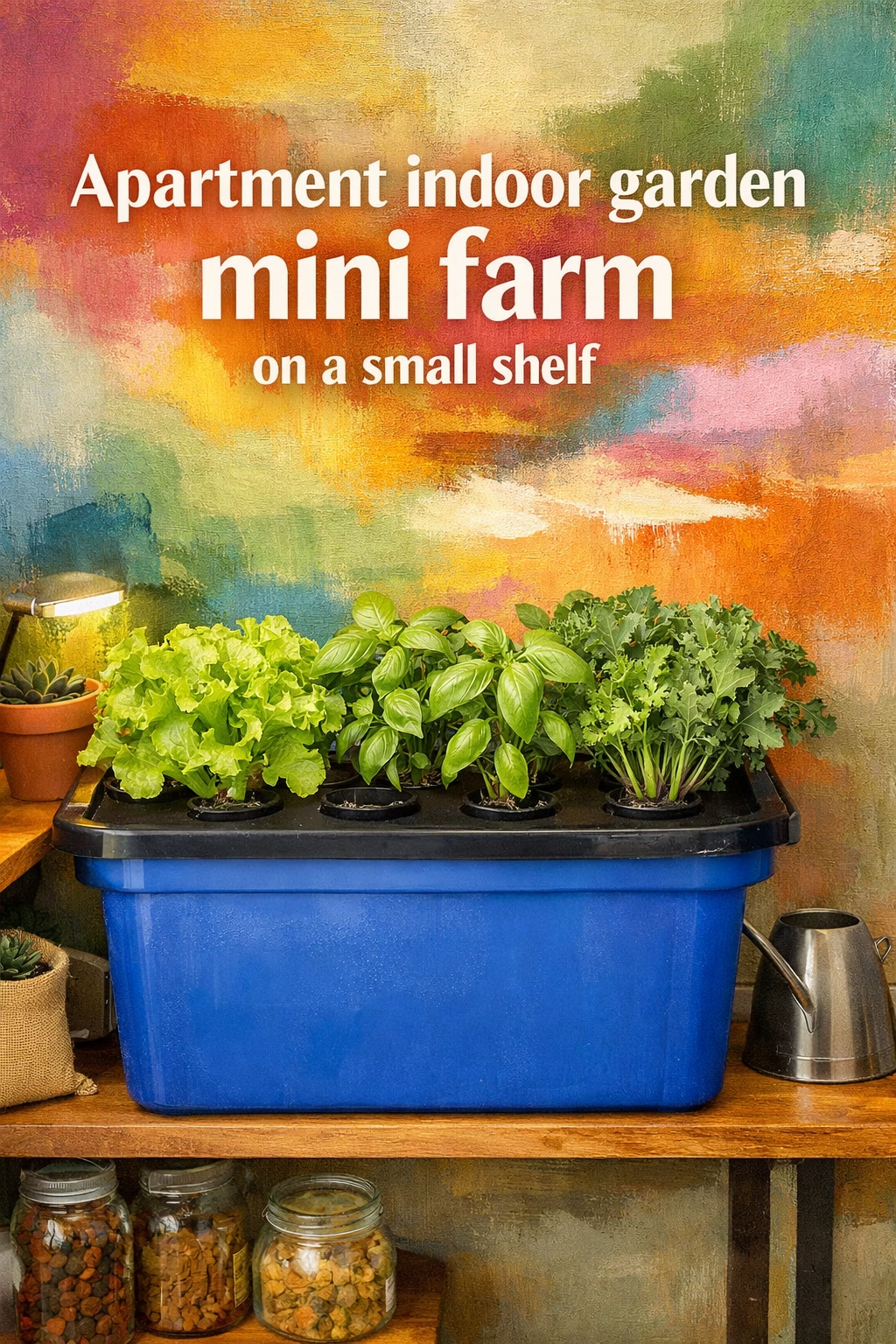
If you’ve ever tried to start an apartment indoor garden and felt like it was weirdly harder than it should be, you are not imagining it. Most “beginner” indoor growing guides are secretly built for people who love hobbies and tinkering, not for people who want fresh greens indoors without turning their kitchen into a small science experiment.
Apartment life adds friction in ways people don’t talk about. You have less space to spread out supplies, less tolerance for clutter, and usually zero interest in noisy equipment, bright lights, or daily maintenance rituals that slowly take over your home. You’re not trying to become an indoor gardening influencer. You’re trying to make dinner easier, grocery runs less frequent, and your food a little more reliable.
That’s why this page exists.
Because the best indoor garden for apartments isn’t the one that looks impressive online. It’s the one you’ll actually keep running when you’re busy, tired, and not in the mood to troubleshoot anything.
In other words, the best system is the one that feels simple enough to become normal.
If you want the full step-by-step setup (plus the shopping list and the perpetual calendar so you don’t have to remember anything), you can grab it here:
👉 Check out the Indoor Mini Farm System
What you’ll learn about indoor apartment gardens
- Why apartment indoor gardens fail (even when you’re motivated)
- The indoor garden setup that actually works in apartments
- What you can grow indoors in a tiny space
- How much space you really need
- The 10-minute weekly routine (what you actually do)
- What to buy (simple, beginner-friendly list)
- Common problems (and quick fixes)
- FAQ: apartment hydroponics + indoor growing
- Next steps (build yours)
Why apartment indoor gardens fail (even when you’re motivated)
Most people don’t fail at indoor growing because they’re lazy, careless, or “bad with plants.” They fail because the setup they chose demands too much attention, too many decisions, and too many steps that are easy to skip when life gets busy.
The usual pattern looks like this: you get excited, you buy the supplies, you set everything up, and for a few days it feels fun and promising. Then the system starts asking things of you. It needs checking, adjusting, cleaning, topping off, moving, troubleshooting, tweaking. You miss one step, the plants stall, something starts looking strange, you feel like you did it “wrong,” and the whole project becomes one more source of guilt in your home. That’s when most people quietly stop.
Apartments add even more friction because everything is right there in your living space. If your system is messy, annoying, loud, or demanding, there’s nowhere to hide it. You can’t just move it outside. You can’t easily “deal with it later.” It’s just… there, taking up precious space and asking for attention you don’t want to give.
The real problem isn’t effort. It’s friction.
If a system feels complicated, it won’t last. Even a motivated person won’t stick with something that constantly creates tiny problems. So instead of building an indoor garden like a hobby, we build it like a system that stays running in real life.
The indoor garden setup that actually works in apartments
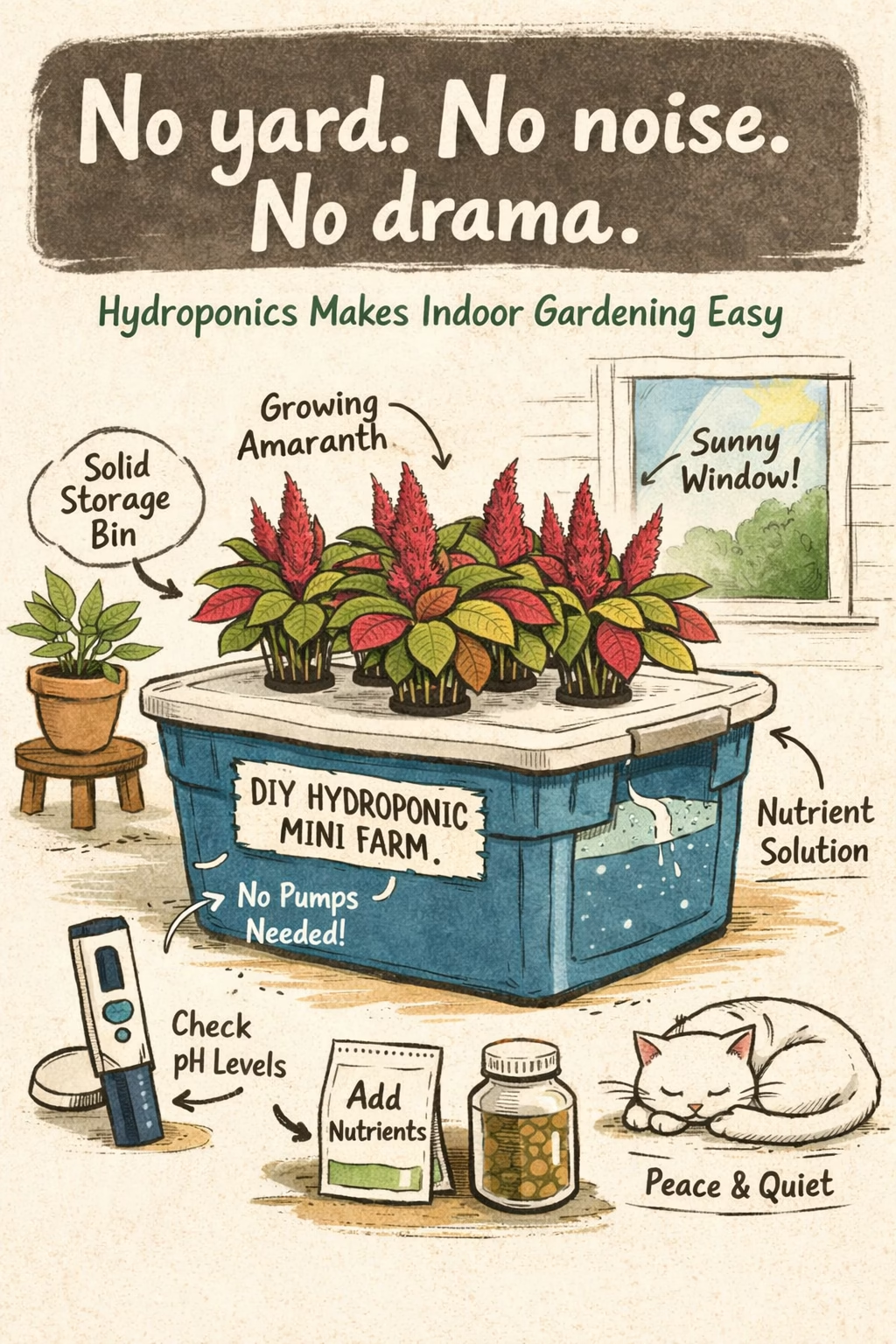
An indoor garden that works in an apartment has a completely different personality than most beginner setups. It has to be quiet, contained, stable, and repeatable, and it needs to be something you can maintain without rearranging your entire day. That’s why the simplest indoor hydroponic garden for beginners is usually the one with the fewest moving parts and the least “specialness.”
The indoor mini farm approach is built around a very practical idea: if a step feels annoying, you won’t do it forever, and if you won’t do it forever, it shouldn’t be required for the system to work. That’s not pessimism; it’s just honest design.
So the best apartment setup makes the common tasks feel easy:
- refilling doesn’t feel like a chore
- checking progress takes seconds, not minutes
- cleaning doesn’t require disassembly and frustration
- harvesting feels rewarding instead of stressful
You also want a setup that doesn’t punish you for being human. If you’re exhausted, it should still work. If you forget something once, it should still recover. If you go out of town, it shouldn’t become a disaster scene.
That’s what we’re building.
And if you want my exact “do this next” process, that’s the point of the Indoor Mini Farm System — it’s the build, the shopping list, and the routine all in one place.
What you can grow indoors in a tiny space
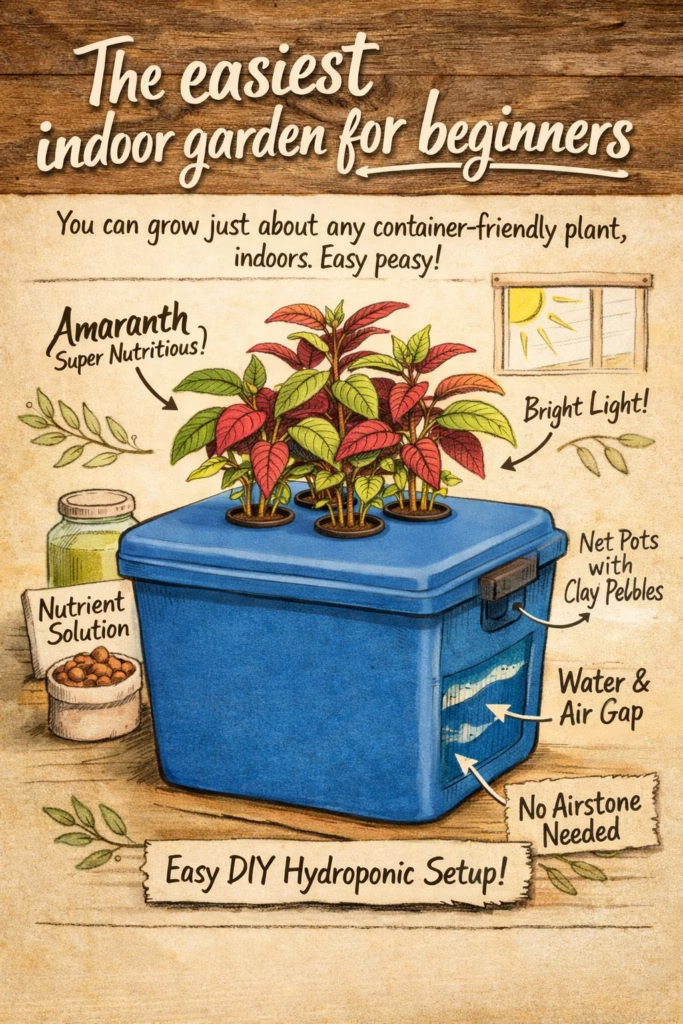
The easiest way to succeed quickly with an apartment indoor garden is to start with fast-growing greens, because greens are forgiving, they reward you quickly, and they don’t require a complicated setup. When you can harvest something early, you build momentum, and momentum is what turns this into a real habit instead of a short-term burst of motivation.
In a small indoor mini farm, you can do extremely well with leafy greens and herbs, especially the kinds that grow quickly and tolerate imperfect conditions. The goal isn’t to “maximize yield” on day one. The goal is to create a reliable source of fresh greens that you can keep producing without thinking about it.
What I don’t recommend for beginners is starting with big, slow, complicated plants that take forever to pay you back. Fruiting crops can be amazing later, but early on they tend to create a longer delay between effort and reward, and that delay makes it easier to quit. In an apartment, you want the results to show up fast so the setup feels worth keeping.
If you want a simple “easy-mode” list for what to grow first, you can add the freebie on my top three favorite seeds to start with:
How much space you really need
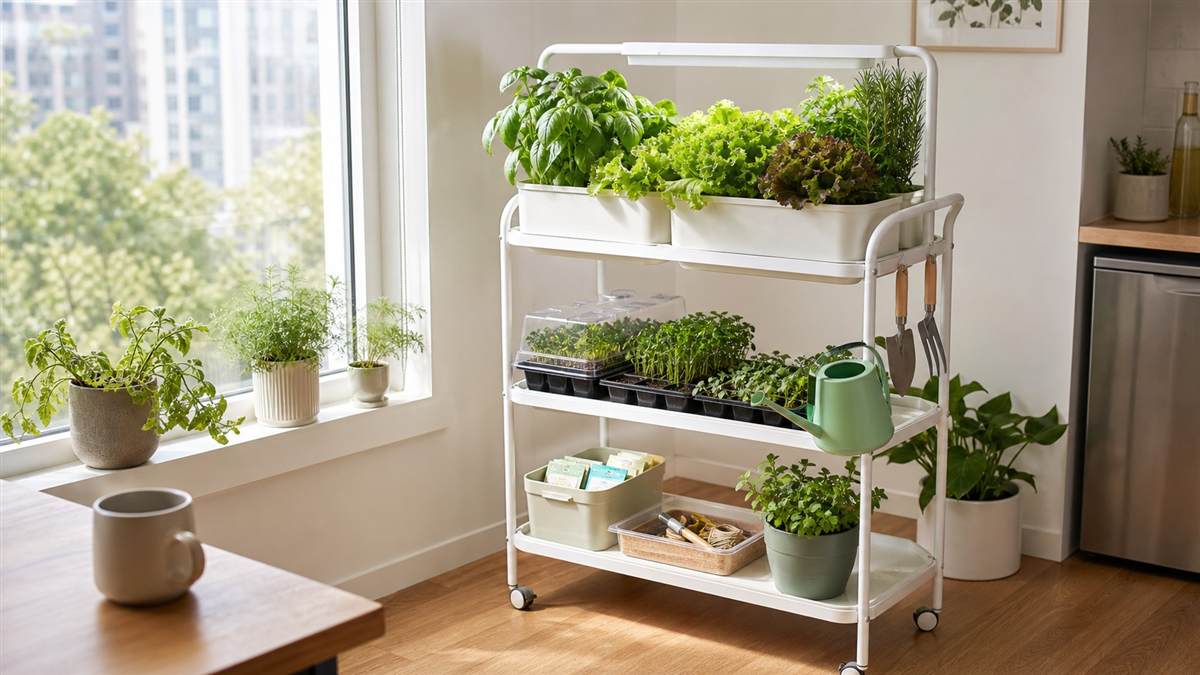
One of the biggest misconceptions about indoor growing is that you need an entire room. You don’t. You need a footprint that can stay stable, clean, and undisturbed, and for most people, that’s a shelf, a corner, a rolling cart, or one dedicated surface that doesn’t constantly get repurposed for something else.
A good beginner target is about five square feet, because it’s enough space to get consistent output without creating apartment chaos. Five square feet gives you room to learn, room to harvest, and room to keep things contained, which matters more than people realize. When a setup spills into other areas of your life, it becomes annoying. When it stays contained, it becomes normal.
Start small, get it running, and then scale up only when you’re already winning.
The 10-minute weekly routine (what you actually do)
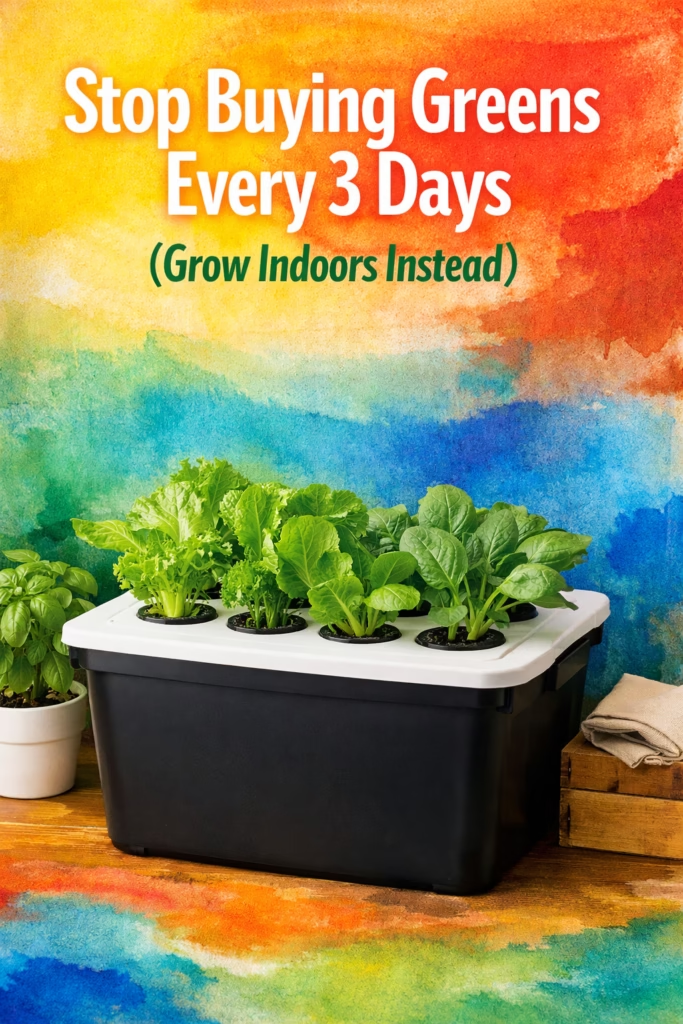
This is where most people get surprised, because a properly designed system doesn’t require constant attention. If you’ve been reading guides that make indoor growing sound like a daily responsibility, I want you to hear this clearly: the goal is a system that can survive on a simple, repeatable routine.
Your routine should feel like this:
You glance at the plants, mostly to confirm they look fine and upright and normal. You refill whatever needs refilling. You harvest a handful. Then you reset the system so it stays easy next week. That’s it.
The biggest difference between an apartment indoor garden that lasts and one that fails is whether the routine feels small enough to keep doing. That’s why I include a perpetual calendar inside the Indoor Mini Farm System — not because you can’t remember things, but because you shouldn’t have to. You should be able to follow a simple “do this next” process and move on with your life.
If you want that calendar and the full routine, it’s here:
What to buy (simple, beginner-friendly list)
I’m not going to dump an overwhelming shopping list on you in this post, because that’s exactly how beginner guides create confusion. Most people don’t need more supplies. They need less.
For an easy indoor hydroponic setup in an apartment, you really just need a stable place to grow, containers that don’t leak, a simple way to start plants, and a routine you can stick to. You also need the right seeds for early wins, because “the right plant” matters less than “the right first experience.”
The best beginner strategy is almost always: buy fewer things, start smaller than you think, and get it running. Once you’re harvesting consistently, you’ll know exactly what upgrades are worth it, because you’ll be upgrading from experience instead of anxiety.
If you want my exact shopping list that helps you avoid overbuying, it’s included inside the system:
A quick note about “hydroponics” in apartments
Some people love the word “hydroponics,” and some people hate it, but what most people mean when they search “hydroponics” is much simpler than the internet makes it sound. They want a clean indoor growing system that doesn’t require a ton of equipment, doesn’t demand daily maintenance, and doesn’t create a mess in their home.
If your goal is a simple indoor garden that’s quiet, contained, and beginner-friendly, you’re in the right place.
And if you specifically want the simplest “no-drama” approach, I also wrote a supporting guide focused on pump-free beginner setups:
👉 https://profitablehomesteader.com/pump-free-hydroponics-apartment/
Common problems (and quick fixes)
Indoor mini farms fail for predictable reasons, and that’s actually good news because predictable problems are easy to fix once you know what they are.
If your plants look sad or stalled, most of the time it isn’t a mystery. It’s usually inconsistency, too many variables at once, or starting with a plant that’s fussier than it needs to be for a beginner. The fastest fix is to simplify the system and aim for easy wins again, because success builds momentum, and momentum makes everything easier.
If anything smells “off,” that’s your sign to clean and reset, because this shouldn’t smell bad. A tidy apartment setup stays tidy, and a clean setup is much easier to keep running.
If the system feels messy, the fix is containment. In an apartment, containment is everything. Your system should feel like one contained unit that you can wipe down and maintain without turning your living space into a project zone. If you have to keep cleaning around it, you’re going to quit, and it won’t be because you lack discipline — it will be because you built a system that demanded more than your home could comfortably hold.
If you keep forgetting what to do, the fix isn’t “try harder.” The fix is a repeatable next-step process that tells you what matters and when. That’s exactly what the perpetual calendar is for.
“But I don’t want to spend a fortune”
You don’t need to.
A lot of indoor garden products are expensive because they’re packaged and priced like gadgets, and that creates this illusion that successful indoor growing requires a big shiny purchase. What you actually want is a repeatable system that stays running without constant replacements, constant upgrades, or constant troubleshooting.
That’s why this is designed as a practical indoor mini farm system, not a “cool toy” that only works when you’re in the mood to babysit it.
FAQ: apartment hydroponics + indoor growing
Is indoor gardening worth it in an apartment?
Yes, as long as the setup is small, clean, and consistent. The goal isn’t perfection — it’s reliable greens that are easy to maintain.
What is the easiest indoor garden for beginners?
A system with fewer moving parts, fewer steps, and faster plants. Beginners do best when they get quick wins and build momentum.
Do I need a pump?
Not always. Many beginners prefer pump-free approaches because they’re quieter and simpler, which matters a lot in apartments.
How much time does an indoor mini farm take?
If it’s designed properly, the routine should take minutes. The system should fit your life, not demand you reorganize your life around it.
What should I grow first?
Start with easy greens so you build confidence quickly, then expand once the system is running smoothly.
Next steps (build yours)
If you want an apartment indoor garden that actually works, here’s the simplest path: pick a small footprint that can stay stable in your home, start with easy greens, and build a routine that feels so small you can do it even when you’re tired. Then, instead of guessing your way through a dozen different tutorials, follow a step-by-step build that keeps the system contained and repeatable.
That’s what the Indoor Mini Farm System is for. It gives you the build, the shopping list, and the perpetual calendar so you don’t have to overthink any of it.
👉 Get The Indoor Mini Farm System here: